

From “Drawing Chores” to “Articulation”: Shifting the Focus from Manual Sketching to Conversational Design
For decades, creating UML diagrams has been widely regarded as one of the more tedious aspects of software design. Developers and architects spent hours painstakingly dragging shapes onto a canvas, aligning connectors with pixel-level precision, adjusting layout to avoid crossing lines, remembering obscure notation rules, and then—often within days—having to redo large portions of the work when requirements changed or feedback arrived. This process earned the nickname “drawing chores” for good reason: it felt more like mechanical labor than creative engineering.
Many teams responded by minimizing or entirely avoiding formal modeling. Whiteboard sketches, simple block diagrams in presentation tools, or even plain text descriptions became the de facto standard in fast-moving projects. While these lightweight approaches enabled quick communication, they sacrificed precision, traceability, maintainability, and the ability to serve as a reliable long-term reference. The result was a persistent tension: either invest heavily in detailed modeling and slow down delivery, or skip it and risk ambiguity, misalignment, and downstream rework.

Visual Paradigm’s AI ecosystem decisively resolves this trade-off by redefining what it means to “model” a system.
Start off with a simple text prompt. Instead of starting with an empty canvas and building diagrams shape-by-shape, users now begin with natural language – exactly the way they already think and talk about problems. A single descriptive prompt such as:
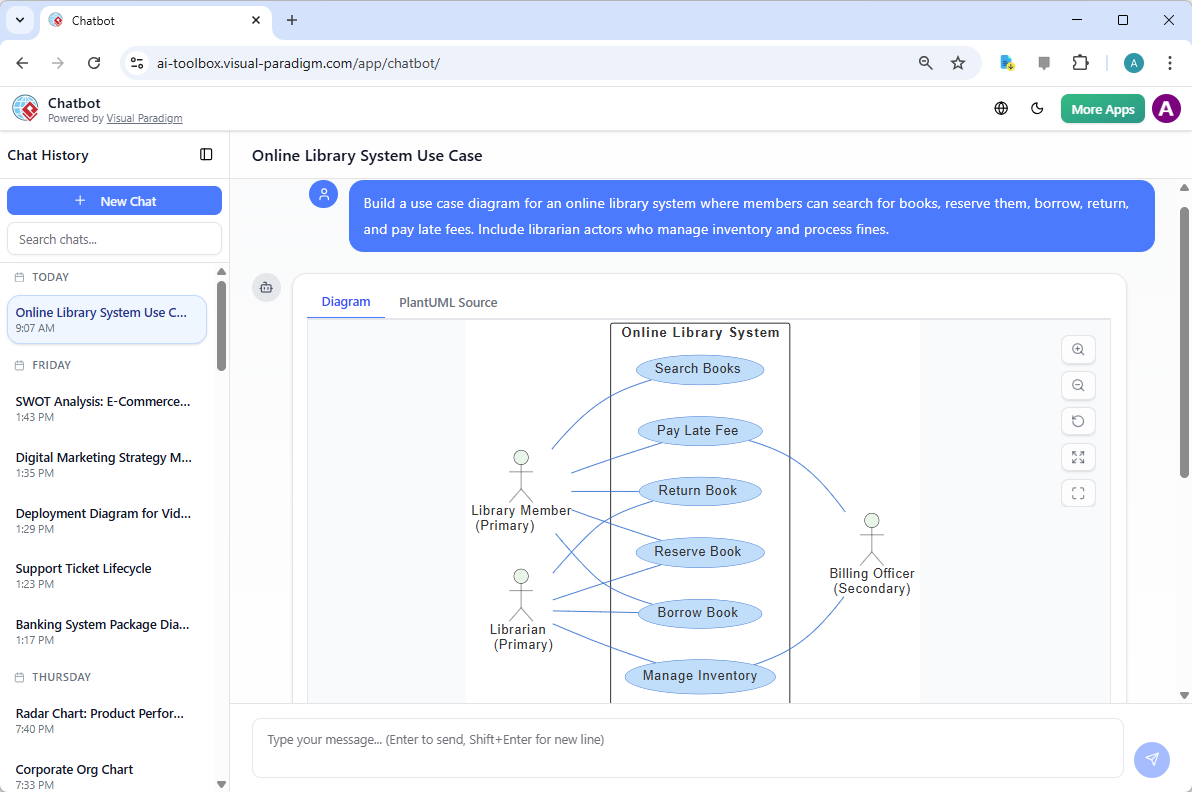
“Build a use case diagram for an online library system where members can search for books, reserve them, borrow, return, and pay late fees. Include librarian actors who manage inventory and process fines.”
can produce a complete, correctly notated Use Case Diagram in seconds, using Visual Paradigm’s AI Chatbot for visual modeling – actors properly positioned, ovals sized consistently, include/extend relationships suggested where appropriate, and system boundary clearly delineated.
From that moment forward, refinement becomes conversational rather than graphical:
- “Add the ‘Renew loan’ use case and make it extend ‘Borrow book’ when the member is premium.”
- “Show that ‘Pay late fee’ includes ‘Send payment reminder’.”
- “Move the Librarian actor to the left side and make the diagram more compact.”
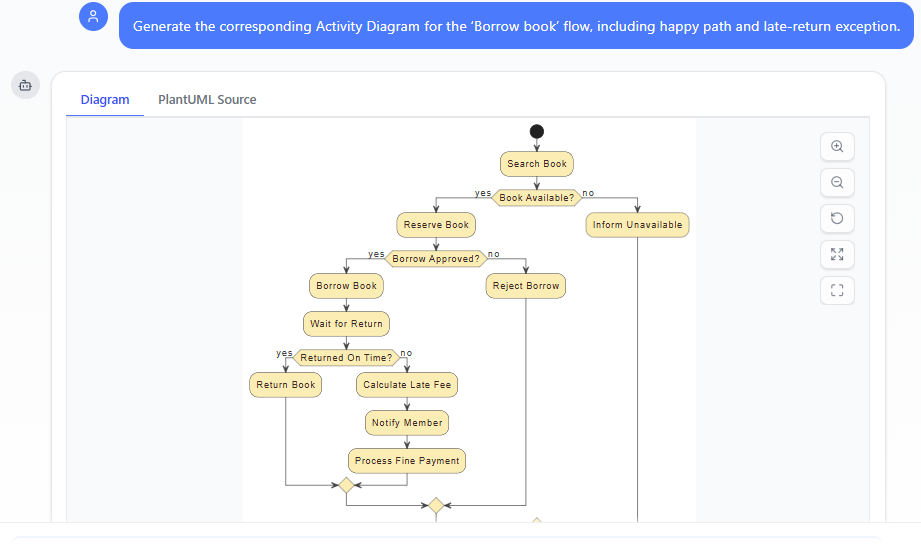
- “Generate the corresponding Activity Diagram for the ‘Borrow book’ flow, including happy path and late-return exception.”
Each instruction updates the living diagram without forcing the user to manually reconnect lines, reposition elements, or fight layout algorithms. This is made possible by Visual Paradigm’s persistent model-aware editing and Diagram Touch-Up technology: the AI understands not only UML syntax but also the semantic intent behind the change, preserving layout intent, connector routing logic, and diagram readability while applying the requested modification.
The psychological and practical shift is profound:
| Aspect | Traditional Manual Modeling | AI-Driven Conversational Modeling with Visual Paradigm |
|---|---|---|
| Starting point | Blank canvas | Plain English description |
| Primary skill required | Tool proficiency + notation mastery | Domain knowledge + ability to express ideas clearly |
| Iteration cost | High (redraw, reconnect, realign) | Low (type instruction → instant safe update) |
| Change propagation | Manual and error-prone | Automatic and semantics-aware |
| Focus of effort | Mechanics of drawing | Articulating system intent and refining meaning |
| Accessibility | Steep learning curve | Beginner-friendly with expert-level output |
| Time to first meaningful diagram | Minutes to hours | Seconds to minutes |
This transition—from drawing chores to articulation—mirrors earlier revolutions in software tooling:
- Hand-writing assembly → high-level languages
- Manual memory management → garbage collection
- Static HTML tables → modern CSS frameworks
- Command-line Git → visual merge tools and pull-request flows
In each case, the drudgery of mechanics was offloaded to smarter tools, freeing human attention for higher-order concerns: architecture, trade-offs, user value, quality, and innovation.
With Visual Paradigm AI, modeling finally joins that list. The act of creating and evolving UML diagrams becomes an almost verbal, interactive dialogue with an intelligent partner – one that never forgets the rules of UML 2.5, never misplaces a connector, and never requires you to fight the tool to express your intent.
The remainder of this course demonstrates exactly how to have that dialogue effectively across every major UML diagram type and architectural viewpoint.