

Welcome to Module 7 of Mastering UML with Visual Paradigm AI: From Natural Language to Professional System Blueprints. By this point, you have constructed a complete, multi-dimensional model of the system: domain structure, functional goals, behavioral dynamics, modular components, deployment topology, and—where required—precise timing constraints. These artifacts collectively form a robust, traceable blueprint ready for implementation.
Module 7 elevates the modeling practice from individual diagram mastery to holistic architectural governance. Here we focus on advanced frameworks that provide higher-level views of the system, ensure consistency across abstraction layers, detect architectural drift early, and align the technical design with strategic business objectives. The emphasis shifts from “building correct diagrams” to “building correct systems”—systems that are scalable, maintainable, evolvable, and aligned with modern enterprise patterns.
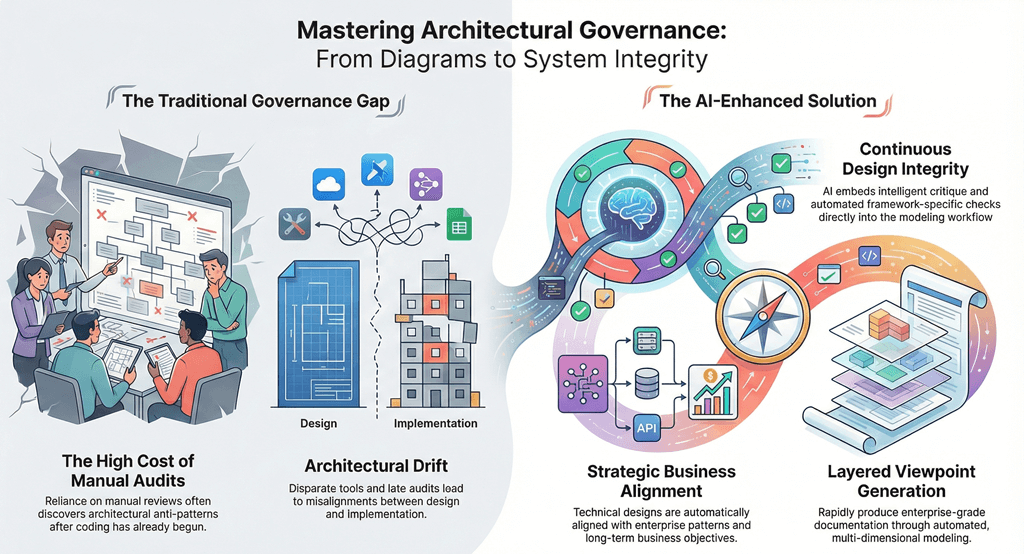
Traditional approaches to these concerns often rely on manual reviews, disparate tools, or late-stage audits—leading to costly rework when architectural anti-patterns, single points of failure, or misalignments are discovered after coding has begun. Visual Paradigm’s AI ecosystem changes this by embedding intelligent critique, layered viewpoint generation, and framework-specific automation directly into the modeling workflow, enabling continuous design integrity checks and rapid production of enterprise-grade architectural documentation.
Overview
The primary objectives of Module 7 are to:
- Apply the C4 Model to generate consistent, zoomable views across four abstraction levels (System Context → Containers → Components → Code) from natural language or existing models.
- Use ArchiMate to create layered enterprise architecture viewpoints that connect business motivation, processes, applications, technology, and motivation layers—aligned with frameworks such as TOGAF ADM.
- Leverage AI Architectural Critique to automatically identify logical gaps, single points of failure, circular dependencies, over-coupling, violation of architectural fitness functions, and other integrity risks—acting as an always-available design reviewer.
- Ensure end-to-end traceability and coherence across all previously created models (UML, C4, ArchiMate, SysML where applicable).
- Produce high-level architectural artifacts suitable for executive summaries, architecture review boards, governance committees, and long-term system documentation.
Key AI-Powered Techniques You Will Master
- The C4 Model Hierarchy Describe the system at any level of detail or paste existing lower-level models. The AI generates layered C4 views:
- Level 1: System Context (external actors & systems)
- Level 2: Container Diagram (applications, services, databases, mobile/desktop clients)
- Level 3: Component Diagram (internal modular structure)
- Level 4: Code-level class/sequence snippets (optional) All views remain consistent and drill-down navigable.
- Enterprise Architecture with ArchiMate Create ArchiMate viewpoints that span:
- Business layer (actors, processes, services, products)
- Application layer (components, interfaces, functions)
- Technology layer (nodes, devices, paths, artifacts)
- Motivation & strategy (drivers, goals, principles, requirements) AI suggests appropriate viewpoints (e.g., Application Cooperation, Technology Infrastructure, Motivation Realization) and maintains traceability to underlying UML models.
By the end of this module, you will be able to:
- Produce C4 model hierarchies that provide zoomable, stakeholder-appropriate views of the entire system.
- Build ArchiMate-based enterprise architecture artifacts that align technology decisions with business strategy and governance requirements.
- Use AI-driven critique to continuously validate design integrity, catch subtle architectural flaws early, and improve overall system quality.
- Maintain a coherent, multi-framework model repository that supports governance, compliance, audit, and long-term evolution.
- Generate executive-ready architectural documentation with minimal manual effort.
This module marks the transition from tactical modeling to strategic architectural thinking. With AI handling viewpoint generation, consistency checks, pattern recognition, and critique, you can focus on high-value decisions: fitness for purpose, alignment with business outcomes, resilience under growth and change, and long-term technical health.
The foundation is now not only complete but actively self-aware and self-correcting. In the final module, we turn these living models into executable assets—code, databases, documentation, and collaborative team deliverables—closing the loop from vision to deployed reality. Let’s ensure the architecture is not only correct, but wise.