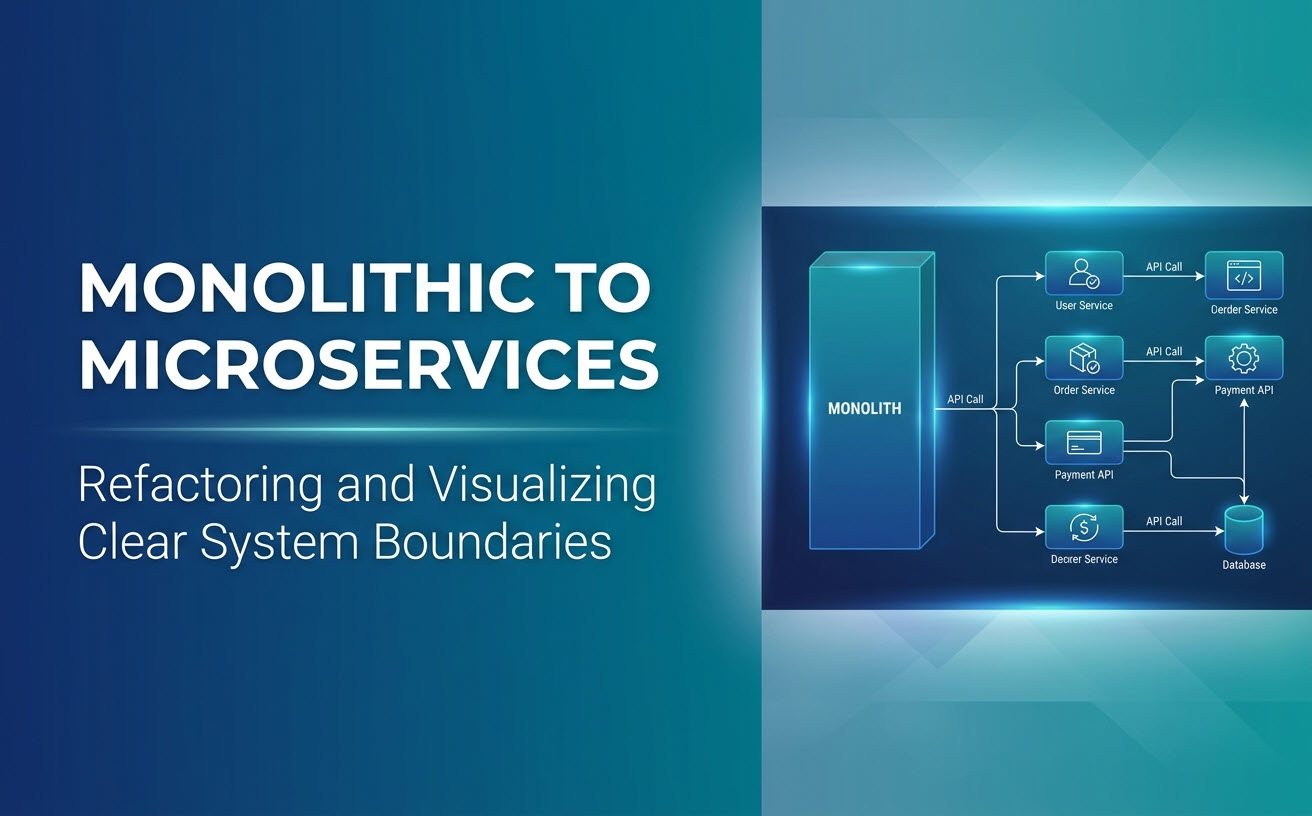
Transitioning from a monolithic architecture to a microservices-based system is one of the most critical structural shifts a engineering team can undertake. Without clear visual blueprints of service boundaries and interface dependencies, refactoring risks creating a “distributed monolith”—combining the complexity of microservices with the tight coupling of a monolith.
Understanding Monolithic vs. Microservices Architectures
Choosing between a monolithic and microservices pattern impacts how software is developed, deployed, scaled, and maintained:
Monolithic Architecture
In a monolithic architecture, all software components—from database access layers and core business logic to user interface controllers—are packaged and deployed as a single unified unit. While simpler to test and deploy initially, monoliths can become difficult to scale and maintain as codebase size and team headcount grow.
Microservices Architecture
A microservices architecture decomposes a system into small, autonomous, loosely coupled services. Each service represents a distinct business capability, manages its own data persistence, and communicates with other services over light-weight protocols (such as REST APIs, gRPC, or message queues).
The Importance of Visualizing Service Boundaries
Defining where one service ends and another begins (domain boundaries) is the core challenge when designing microservices. Poorly defined service boundaries lead to severe operational issues:
- Hidden Coupling: Services sharing databases or calling each other synchronously create tight runtime dependencies.
- Data Ownership Ambiguity: Unclear boundaries make it difficult to determine which service owns specific domain models.
- Cascading Failures: A failure in one service can easily bring down dependent components across the network.
UML Component Diagrams provide a clear, standardized way to visualize service interfaces (provided/required contracts), data flow dependencies, and communication protocols before writing microservice code.
Refactoring Monoliths with an AI UML Tool
Manually re-architecting a monolithic system into modular services requires constant iteration. Using a modern AI UML tool allows software architects to rapidly explore alternative boundary configurations using plain text descriptions.
The Visual Paradigm AI Diagramming Chatbot—a core component of the Visual Paradigm AI Ecosystem—helps engineering teams model and decompose complex systems interactively through simple chat prompts.
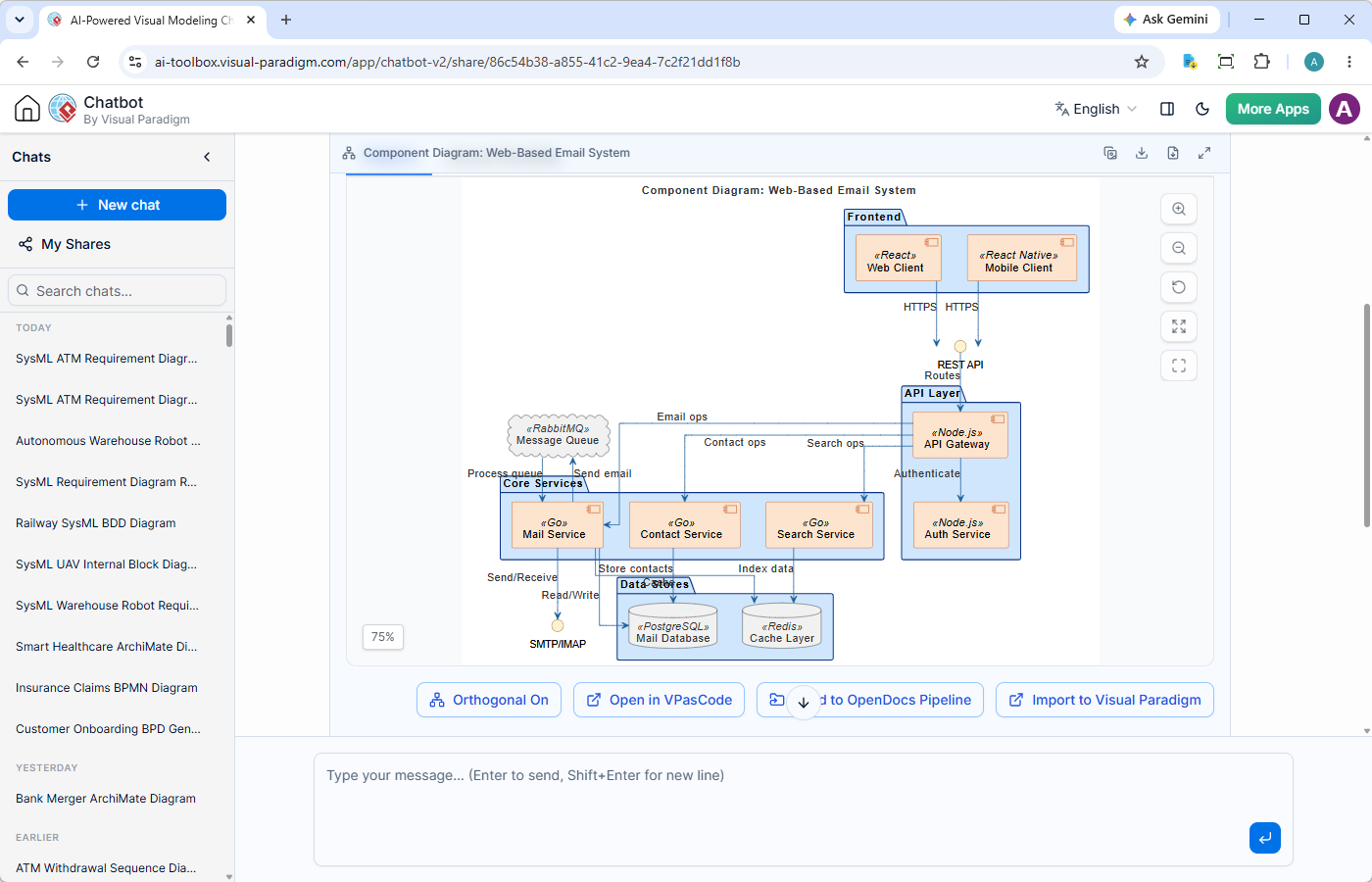
How AI Chatbot Accelerates Architectural Refactoring:
- Prompt-Based Decomposition: Provide a description of your monolithic system, and ask the AI to suggest logical microservice component boundaries and API interfaces.
- Iterative Boundary Adjustments: Refine models conversationally—such as converting a shared database module into isolated per-service databases or adding an Event Broker component.
- Multi-Notation Support: Visualize your system from multiple perspectives. Generate structural component diagrams, C4 container views, or process flows using the built-in AI activity diagram tool capabilities.
- Low-Error Diagram Engine: Unlike generic LLMs that produce syntax errors, Visual Paradigm utilizes a specialized, highly trained model ensuring syntactically and semantically accurate diagram code.
- Portable Text Output: Generated diagrams leverage open text standards (PlantUML, Mermaid, Graphviz) that are easy to copy, edit, or integrate into automated documentation pipelines.
Connecting Service Models to the Visual Paradigm Ecosystem
Once you have defined your target microservices architecture using the AI Chatbot, seamlessly integrate your models into your engineering workflow:
- OpenDocs Integration: Export your component models directly to Visual Paradigm OpenDocs to publish clear API boundary specs, service contracts, and architectural decision records (ADRs).
- VPasCode (Architecture as Code): Edit diagram text directly in VPasCode.
- VP Online Whiteboarding: Share session links or move diagrams to VP Online to host virtual architectural workshops and collaborative design reviews with distributed teams.
- VP Desktop Traceability: Import diagrams into Visual Paradigm Desktop to map high-level component interfaces directly to implementation code structures and deployment nodes.
Try Visual Paradigm AI Tools Today
Whether you are designing a new cloud-native microservices platform or refactoring an existing monolithic codebase, Visual Paradigm provides a flexible solution for every stage of system modeling.
Explore the AI Chatbot with a free trial. Full access is included with both VP Online Deluxe Edition and VP Desktop Professional Edition licenses.