


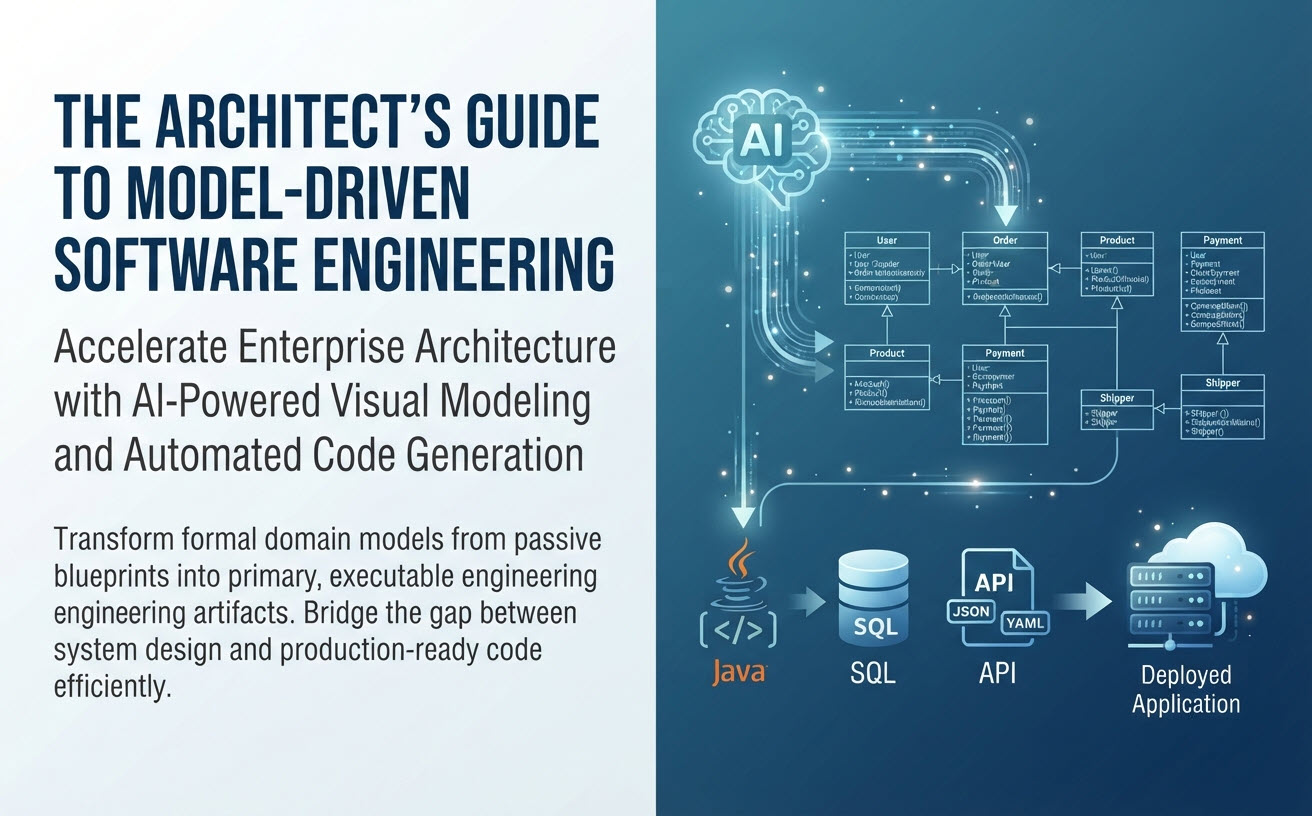
In modern software architecture, managing complexity while maintaining agility is a constant challenge. Model-Driven Software Engineering (MDSE) elevates visual models—such as UML class diagrams, state machines, and sequence flows—from passive documentation into primary, executable engineering artifacts. By combining MDSE with modern AI class diagram generators, architects can bridge the traditional gap between system design and production-ready code.
What is Model-Driven Software Engineering (MDSE)?
Model-Driven Software Engineering (MDSE) is a software development methodology where formal domain models serve as the foundation for design, analysis, simulation, and automated code generation.
Rather than treating architecture diagrams as static blueprints that become outdated after implementation, MDSE treats models as the single source of truth. From these models, developers generate source code skeletons, database DDL scripts, API contracts, and technical documentation automatically.
MDSE vs. MDA vs. MDE
While often used interchangeably, these terms represent distinct layers of abstraction in model-based design:
- Model-Driven Architecture (MDA): An OMG (Object Management Group) standard framework that defines Platform-Independent Models (PIM) and Platform-Specific Models (PSM).
- Model-Driven Engineering (MDE): A broader domain encompassing model-driven approaches across software, hardware, and systems engineering.
- Model-Driven Software Engineering (MDSE): The practical application of MDE principles specifically tailored to software engineering lifecycles.
The Core Pillars of MDSE Architecture
To successfully execute a model-driven workflow, software architects rely on three primary pillars:
1. Abstraction via Domain Modeling
MDSE allows architects to focus on domain logic without getting bogged down by platform-specific boilerplate. High-level structures, such as object entities, class relationships, and behavioral flows, are captured visually using standard notations like Unified Modeling Language (UML).
2. Model Transformations
The core engine of MDSE is transformation:
- PIM to PSM: Transforming a high-level, platform-independent class model into a platform-specific model tailored for Java Spring Boot, .NET Core, or Python Django.
- Model-to-Text (M2T): Transforming structural class diagrams directly into production code, SQL schemas, or OpenAPI specifications.
3. Model-as-Code and Versioning
Modern MDSE practices store diagram definitions as text-based declarations (such as PlantUML, Mermaid, or Graphviz). This enables architects to version-control structural designs alongside source code in Git, perform pull request diffs, and automate model verification within CI/CD pipelines.
Why Enterprise Architects Adopt MDSE
| Architectural Challenge | Traditional Development | Model-Driven Engineering (MDSE) Solution |
|---|---|---|
| Architecture Drift | Diagrams become outdated as code changes over time. | Code is continuously generated or synchronized with models. |
| Inconsistent Standards | Different developers implement architectural patterns differently. | Generators enforce unified coding standards across all modules. |
| Slow Prototyping | Writing domain classes, getters, setters, and DB links takes days. | AI-driven modeling generates full class structures in seconds. |
Accelerating MDSE with Conversational AI
Historically, one of the biggest bottlenecks in MDSE was the initial visual modeling overhead—drawing dozens of domain classes, attributes, operations, and relationships by hand.
By integrating an modern conversational assistant like the Visual Paradigm AI Diagramming Chatbot, architects can jumpstart MDSE directly from natural language specifications.
Example Prompt: “Design a microservices-ready micro-payroll domain class model with Employee, Timesheet, SalaryStructure, and TaxDeduction classes. Include visibility, methods, and composition connections.”
The AI engine constructs a syntactically correct, code-ready model instantly. Learn more about how this capability fits into full object-oriented workflows on our specialized AI Class Diagram Generator Feature Page.
Executing MDSE within the Visual Paradigm Ecosystem
A model is only as useful as the software suite supporting it. Visual Paradigm provides a complete enterprise toolchain that powers your MDSE pipeline from early ideation to deployed code:
1. Living Architectural Specifications in OpenDocs
Transform your model artifacts into living enterprise data dictionaries and architectural specifications using Visual Paradigm OpenDocs, ensuring stakeholders access documented domain structures.
2. Textual Model Management in VPasCode
Manage your structural designs as pure code. Output PlantUML or declarative diagram scripts from the AI Chatbot straight into VPasCode for minor touch-ups.
3. Collaborative Domain Brainstorming in VP Online
Share and refine initial AI models on an interactive virtual whiteboard with VP Online, allowing cross-functional teams to collaborate on domain boundaries and class hierarchies in real time.
4. Forward & Reverse Engineering in VP Desktop
Unlock the ultimate MDSE capabilities in Visual Paradigm Desktop. Import your AI-generated class models to perform forward code generation (Java, C#, C++), reverse engineer existing codebases back into UML models, and execute automated model verification checks.