Core banking platforms, payment gateways, and fintech applications demand strict precision, fault tolerance, and security in their underlying software design. Building a robust banking system class diagram requires modeling intricate domain logic—including double-entry accounting ledgers, multi-currency processing, fraud checks, and customer verification. This guide breaks down key fintech architectural patterns and provides copy-and-paste prompts for generating custom models with an AI class diagram generator.
Key Subsystems in Core Banking & Fintech Architecture
An enterprise financial system relies on a modular domain architecture separated into clear boundaries to satisfy compliance, auditing, and scalability demands:
- Customer & KYC Subsystem: Manages account holders, identity verification (KYC/AML status), access credentials, and credit risk profiles.
- Account & Ledger Subsystem: Handles double-entry ledger journals, savings/checking account types, balance states, and interest calculation engines.
- Transaction & Processing Subsystem: Orchestrates money movements, credit/debit entries, pending holds, and authorization rules.
- Payment Gateway & Integration Subsystem: Interfaces with external payment rails (ACH, SWIFT, SEPA, card networks) and handles transaction receipts.
Core Classes and Structural Relationships
Fintech domain models rely heavily on strict object-oriented relationships to guarantee data integrity and auditability across all financial transactions:
1. Account and LedgerEntry (Composition)
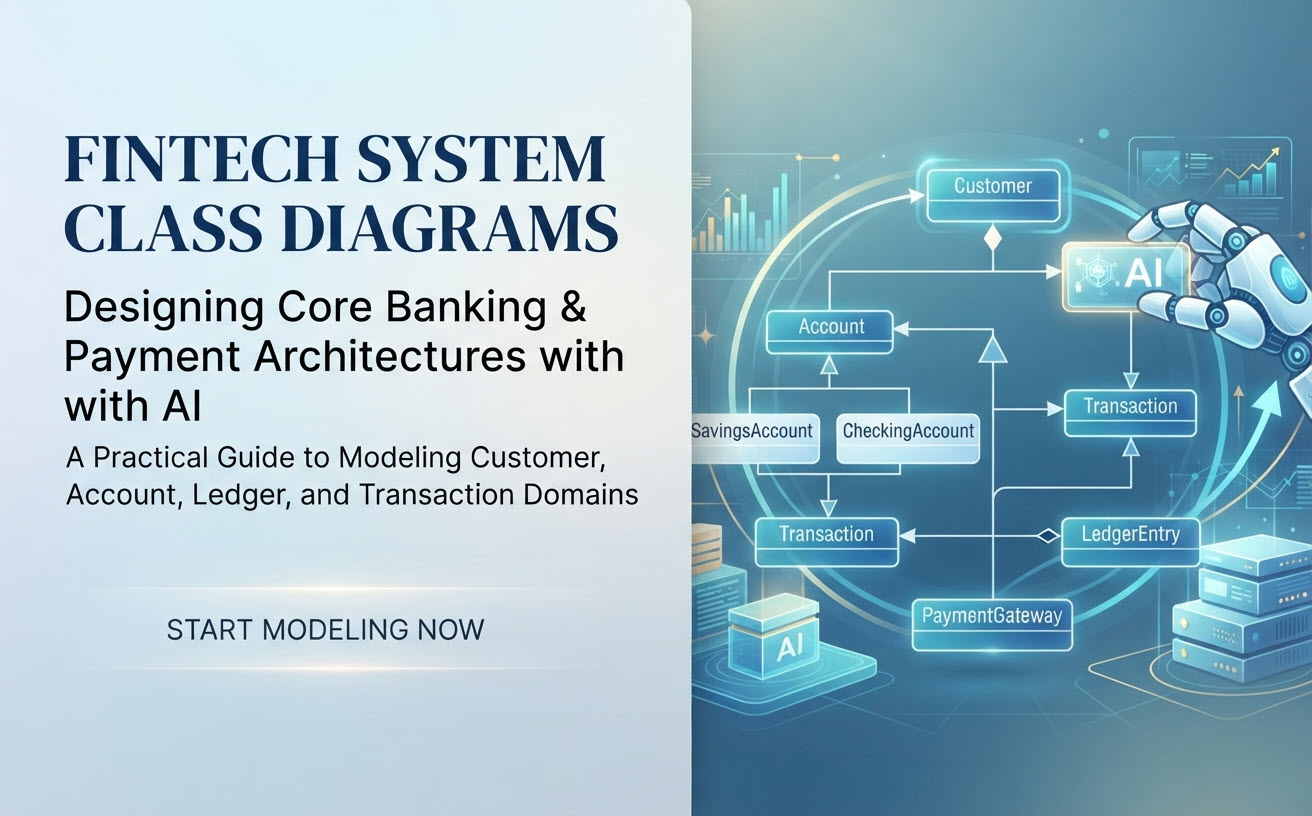
An Account class connects to a LedgerEntry class via a strict **Composition** relationship (represented by a filled diamond on the Account side). Financial records must maintain immutability; a journal ledger entry cannot exist independently without being bound to a parent ledger account.
2. Account Type Hierarchy (Generalization / Inheritance)
An abstract Account superclass defines common properties (such as accountNumber, balance, and currency). Concrete subclasses like SavingsAccount, CheckingAccount, and LoanAccount inherit from Account using **Generalization**, introducing specialized rules like interest rates or overdraft limits.
3. Transaction and PaymentGateway (Realization / Interface)
To decouple internal ledger processing from third-party networks, a PaymentProcessor interface defines abstract contracts like authorize() and settle(). External integration drivers (e.g., StripeAdapter or SwiftAdapter) implement this contract through **Realization**.
4. Customer and RiskProfile (Aggregation)
A Customer entity maintains an **Aggregation** connection (hollow diamond) with a RiskProfile or ComplianceRecord. While linked for fraud evaluation, compliance audit logs can persist independently of an active user session.
Prompt Guide: Generating Fintech Class Diagrams with AI
Designing banking class models manually requires careful attention to method signatures, encapsulation, and relationships. With an AI-driven approach, architects can generate complete financial class skeletons in seconds.
Using the Visual Paradigm AI Diagramming Chatbot, you can use the structured prompts below to produce syntactically valid UML models instantly.
Template 1: Core Banking & Ledger System Prompt
“Generate a UML Class Diagram for a core banking ledger system. Include classes: Customer, BankAccount, SavingsAccount, CheckingAccount, Transaction, LedgerEntry, and AuditLog. Show generalization between BankAccount and its subclasses, composition between BankAccount and LedgerEntry, and association between Customer and BankAccount. Include visibility markers (+, -), attribute types, and methods like deposit(), withdraw(), and calculateInterest().”
Template 2: Fintech Payment Gateway Integration Prompt
“Create a class diagram for a fintech payment processor. Include an interface named PaymentGateway with methods authorizeTransaction() and refund(). Add concrete classes CreditCardProcessor, CryptoPaymentProcessor, and BankTransferProcessor implementing PaymentGateway. Connect these to a TransactionContext class using strategy pattern association.”
Learn more about leveraging conversational modeling for enterprise systems on our specialized AI Class Diagram Generator Feature Page.
From AI Ideation to Production Financial Systems
An AI-generated banking model provides an immediate architectural baseline. Visual Paradigm offers an integrated enterprise toolchain to move your financial models from preliminary prompts into production implementation:
1. Create Compliance Data Dictionaries in OpenDocs
Export your banking class specifications straight into Visual Paradigm OpenDocs to build regulatory-compliant data dictionaries, mapping attributes, data types, and encryption flags for audit reviews.
2. Touch-up with VPasCode
The AI Chatbot outputs clean declarative diagram code (such as PlantUML or Mermaid). Transfer these scripts to VPasCode to manage architecture-as-code, perform minor touch-ups.
3. Collaborative Architecture Reviews in VP Online
Bring security officers, product managers, and developers together on a virtual whiteboard using VP Online to review transaction flows and refine class boundaries interactively.
4. Forward & Reverse Engineering in VP Desktop
Import your domain model into Visual Paradigm Desktop to auto-generate production code skeletons (Java, C#, C++) or reverse-engineer legacy financial codebases back into clean UML class diagrams for auditing.