


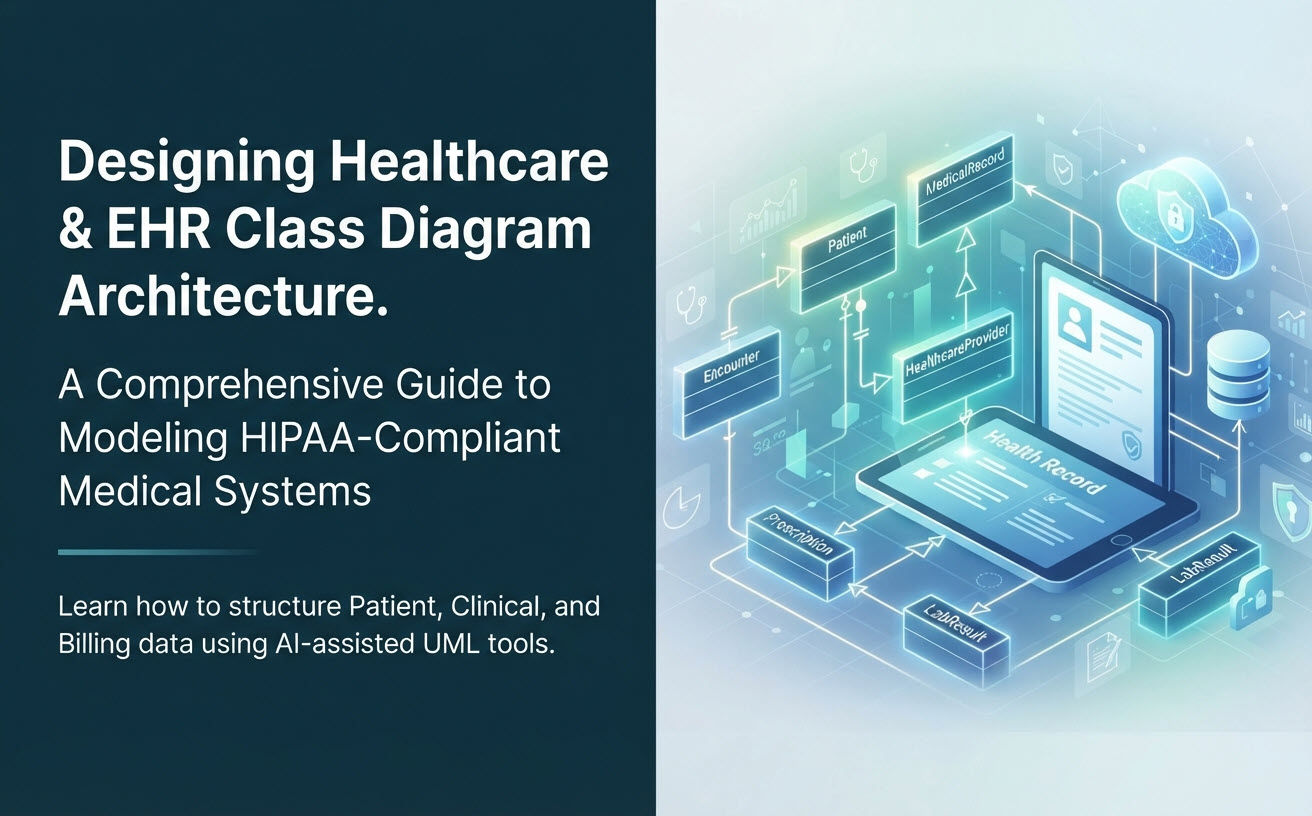
Designing digital healthcare platforms, hospital management suites, and Electronic Health Record (EHR) systems requires strict architectural precision. Medical systems must handle highly interconnected data—ranging from patient demographics and clinical encounters to prescriptions, diagnostic labs, and billing—while maintaining stringent compliance standards like HIPAA and HL7/FHIR. This guide outlines the core reference architecture for an EHR system and provides ready-to-use prompts for generating custom models using an AI class diagram generator.
Key Subsystems in Healthcare & EHR Architecture
An enterprise EHR domain model must be modularized across specialized subsystems to ensure security, data integrity, and seamless clinical workflows:
- Patient & Administration Subsystem: Manages patient master indices (MPI), demographics, emergency contacts, insurance policies, and privacy consent logs.
- Clinical Encounter & Vitals Subsystem: Captures outpatient visits, inpatient admissions, attending physicians, chief complaints, and real-time vital signs.
- E-Prescribing & Medication Subsystem: Tracks active drug orders, dosages, administration routes, pharmacy fulfillment, and allergy cross-checks.
- Diagnostics & Lab Orders Subsystem: Manages lab tests, radiology imaging requests (DICOM references), pathology reports, and diagnostic result flows.
- Billing & Claims Subsystem: Converts clinical encounter codes (ICD-10, CPT) into insurance claims, super-bills, and payment status updates.
Core Classes and Structural UML Relationships
EHR object-oriented designs rely on explicit UML relationship types to enforce medical safety constraints and lifecycle rules within the software structure:
1. Patient and MedicalRecord (Composition)
A Patient class connects to a MedicalRecord class via a strict **Composition** relationship (represented by a filled diamond on the Patient end). A medical record history cannot exist independently without being permanently bound to a specific patient identity.
2. Encounter and ClinicalObservation (Aggregation)
An Encounter (e.g., a doctor visit or hospital stay) maintains an **Aggregation** connection (hollow diamond) with ClinicalObservation records (such as lab results or blood pressure readings). While observations are logged during a specific encounter, historical diagnostic observations remain accessible across the patient’s lifelong health timeline.
3. User Role Hierarchy (Generalization / Inheritance)
An abstract HealthcareProvider superclass defines core identity attributes (such as npiNumber, licenseState, and department). Concrete subclasses like Physician, Nurse, and Radiologist inherit from HealthcareProvider using **Generalization**, introducing specialized clinical capabilities and access permissions.
4. Order and MedicationPrescription (Realization / Interface)
To decouple order entry workflows from specific fulfillment systems, a ClinicalOrder interface defines abstract contracts like signOrder() and cancelOrder(). Specialized classes such as MedicationPrescription and LabOrder implement this contract through **Realization**.
Prompt Guide: Generating EHR Class Diagrams with AI
Mapping complex medical hierarchies manually can be time-consuming and prone to structural mistakes. Software architects can use natural language prompts to auto-generate syntactically accurate healthcare models in seconds.
Using the Visual Paradigm AI Diagramming Chatbot, you can copy and customize the prompts below to produce domain-driven UML skeletons immediately.
Template 1: Core Electronic Health Record System Prompt
“Generate a UML Class Diagram for a HIPAA-compliant Electronic Health Record (EHR) system. Include classes: Patient, MedicalRecord, Encounter, HealthcareProvider, Physician, Nurse, Prescription, and LabResult. Show composition between Patient and MedicalRecord, aggregation between Encounter and LabResult, and generalization between HealthcareProvider and its subclasses. Include attributes with data types, visibility markers (+, -), and methods like recordVitals(), prescribeMedication(), and authorizeAccess().”
Template 2: E-Prescribing & Pharmacy Integration Prompt
“Create a UML class diagram focusing on an e-prescribing subsystem. Include classes: Prescription, Medication, DosageInstruction, PatientAllergy, and Pharmacy. Show association between PatientAllergy and Medication to model allergy checks, and composition between Prescription and DosageInstruction. Add a method checkDrugInteractions() to the Prescription class.”
To learn more about how conversational AI accelerates complex domain modeling, visit our dedicated AI Class Diagram Generator Feature Page.
From AI Blueprint to Enterprise Healthcare Systems
An AI-generated healthcare model gives you an instant, high-level blueprint. Visual Paradigm provides a complete enterprise software ecosystem to take your EHR models through compliance checks, documentation, and source code implementation:
1. Maintain Clinical Data Dictionaries in OpenDocs
Export your healthcare class definitions directly to Visual Paradigm OpenDocs to build comprehensive FHIR-aligned data dictionaries, documenting field-level encryption, data types, and regulatory definitions for engineering teams.
2. Edit Architecture-as-Code with VPasCode
The AI Chatbot generates clean, code-based diagram definitions (such as PlantUML and Mermaid). Transfer these definitions into VPasCode to perform minor touch-ups.
3. Collaborative Workflow Modeling in VP Online
Share clinical models with chief medical information officers (CMIOs) and software engineers using VP Online. Conduct real-time online whiteboarding sessions to fine-tune encounter workflows and permission models using drag-and-drop tools.
4. Code Generation & System Integration in VP Desktop
Import your domain models into Visual Paradigm Desktop for full-lifecycle software development. Generate production-ready source code (Java, C#, C++) or reverse-engineer existing healthcare platforms into clean UML models for architectural auditing and refactoring.