


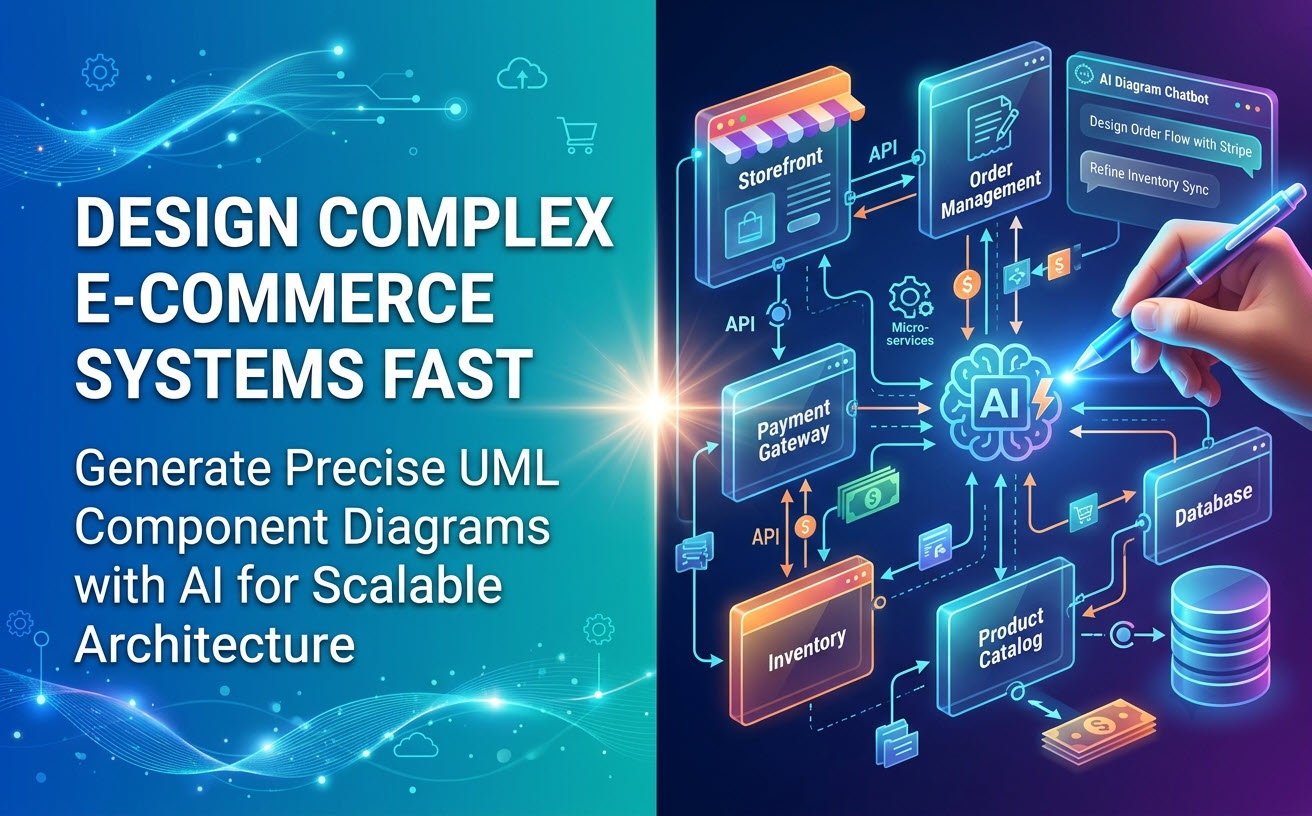
Modern e-commerce platforms are complex, distributed systems requiring seamless coordination between user interfaces, payment gateways, inventory databases, order processing pipelines, and third-party logistics integrations. Using UML Component Diagrams allows software architects to map these service boundaries, clarify API dependencies, and design resilient e-commerce architectures before writing production code.
Core Subsystems in an E-Commerce Architecture
A scalable e-commerce platform relies on well-defined, modular components that isolate business responsibilities. Key architectural building blocks include:
- Storefront & API Gateway: Handles client requests from web, mobile, and third-party channels, routing traffic to underlying backend services.
- Product Catalog Component: Manages product listings, categories, pricing, and search indexing, optimized for high-read throughput.
- Order Management Service (OMS): Coordinates cart checkout, order validation, state transitions, and fulfillment workflows.
- Payment Adapter Component: Exposes standardized payment interfaces while encapsulating integrations with external gateways (such as Stripe, PayPal, or credit card processors).
- Inventory & Warehouse Service: Tracks real-time stock levels, reservations during checkout, and warehouse replenishment alerts.
- Notification Service: Asynchronously dispatches transactional emails, SMS notifications, and order tracking updates.
Mapping Provided and Required Interfaces
In an e-commerce component diagram, mapping provided (lollipop) and required (socket) interfaces ensures that third-party integrations and internal services interact through strict API contracts:
- Payment Gateway Interface: The
Order Servicerelies on a required interface (e.g.,IPaymentProcessor) provided by thePayment Component, preventing hardcoded dependencies on specific payment vendors. - Inventory Sync: The
Checkout Subsystemconsumes a provided interface (e.g.,IInventoryCheck) to verify item availability in real time during checkout. - Event-Driven Bus: High-volume operations, such as order placement, publish events to a central Message Broker component, decoupling long-running background tasks like analytics and notification dispatching.
Generating E-Commerce Diagrams with an AI UML Tool
Designing and iterating on complex e-commerce blueprints manually can be time-consuming. Utilizing an advanced AI UML tool enables architects to generate, refine, and document full e-commerce architectures through natural language prompts.
The Visual Paradigm AI Diagramming Chatbot—part of the Visual Paradigm AI Ecosystem—helps engineering teams rapidly generate accurate, syntactically correct architecture models directly from system requirements.
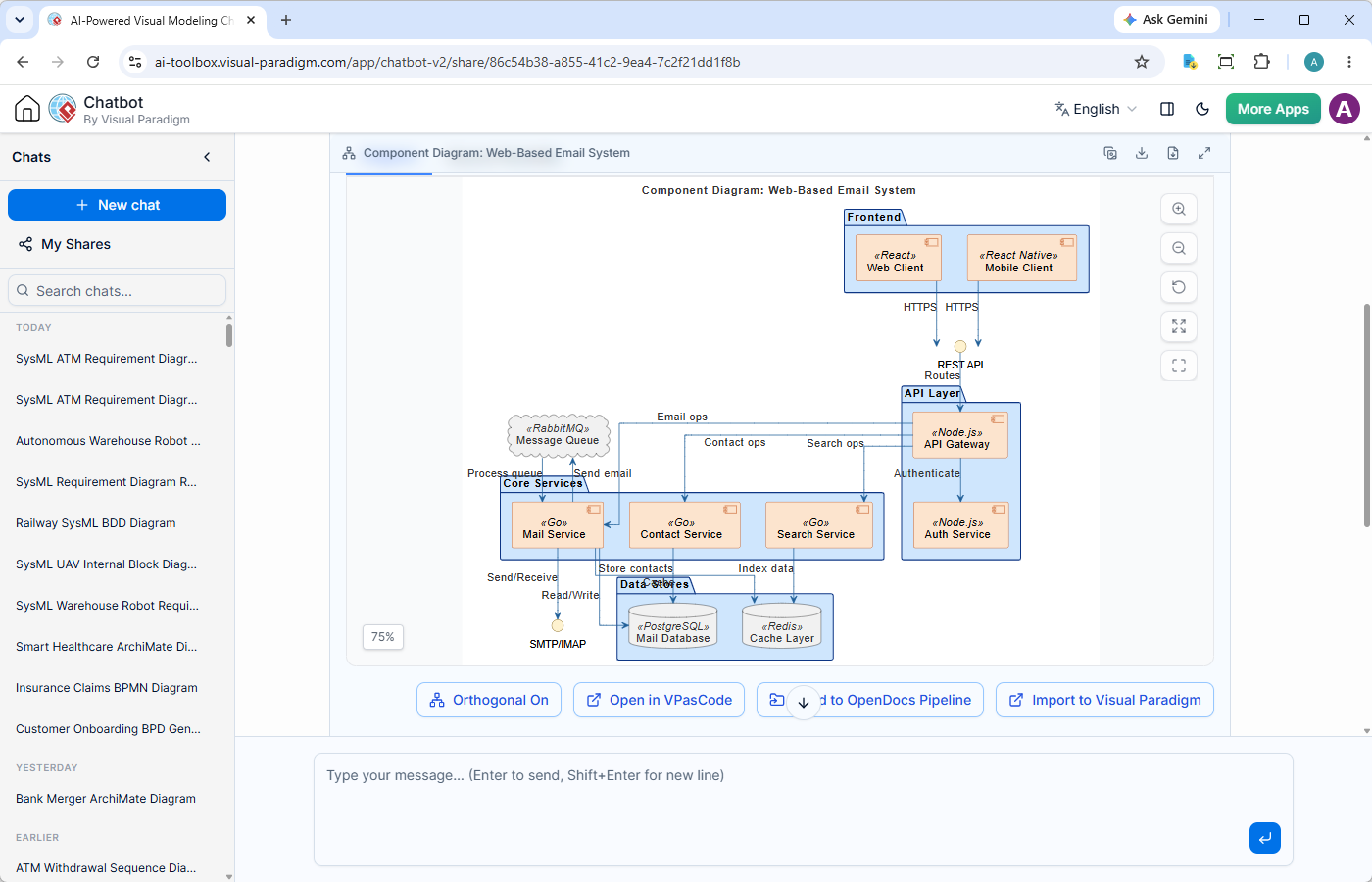
Example Prompts for E-Commerce Modeling:
- “Generate a UML component diagram for a microservices-based e-commerce system including API Gateway, Auth Service, Order Manager, Inventory Database, and Stripe Payment Gateway interface.”
- “Refine the diagram to separate the Product Catalog into a standalone read-heavy service with a Redis caching layer.”
- “Add an asynchronous Message Bus component connecting the Order Manager to a Notification Service and Warehouse Logistics interface.”
Key Chatbot Features for Commerce Architects:
- Conversational Iteration: Modify system boundaries, add fallback payment providers, or split monolithic services simply by describing the changes in plain text.
- High Precision Model Engine: Uses a specialized AI model designed specifically to avoid invalid syntax or illegal interface connections common in general-purpose AI models.
- Multi-Diagram Visualization: Complement component blueprints with process flows using built-in AI activity diagram tool capabilities, or generate sequence diagrams for checkout interactions.
- Portability & Text Output: Models are generated using standard text formats (PlantUML, Mermaid, Graphviz), making it easy to be editor via popular diagram-as-code software such as Visual Paradigm VPasCode.
Connecting E-Commerce Architecture to the Visual Paradigm Ecosystem
Once your initial e-commerce blueprint is generated in the AI Chatbot, Visual Paradigm provides integrated tools to take your design into production:
- Document API Boundaries with OpenDocs: Export your component models directly to Visual Paradigm OpenDocs to publish clear interface specifications, payment integration contracts, and service boundary documentation for frontend and backend teams.
- Manage Architecture-as-Code in VPasCode: Edit diagram code in VPasCode to control your system designs.
- Collaborate via VP Online: Share persistent chat sessions or export your component diagrams to VP Online for real-time team whiteboarding and architectural review sessions.
- Trace to Code in VP Desktop: Import component blueprints into Visual Paradigm Desktop to link high-level architectural components directly to concrete implementation classes and deployment packages.
Design Your E-Commerce Architecture Today
Accelerate your e-commerce platform design using AI-driven component modeling. Test the Visual Paradigm AI Diagramming Chatbot with a free trial.
Unrestricted access is included with both VP Online Deluxe Edition and VP Desktop Professional Edition licenses.