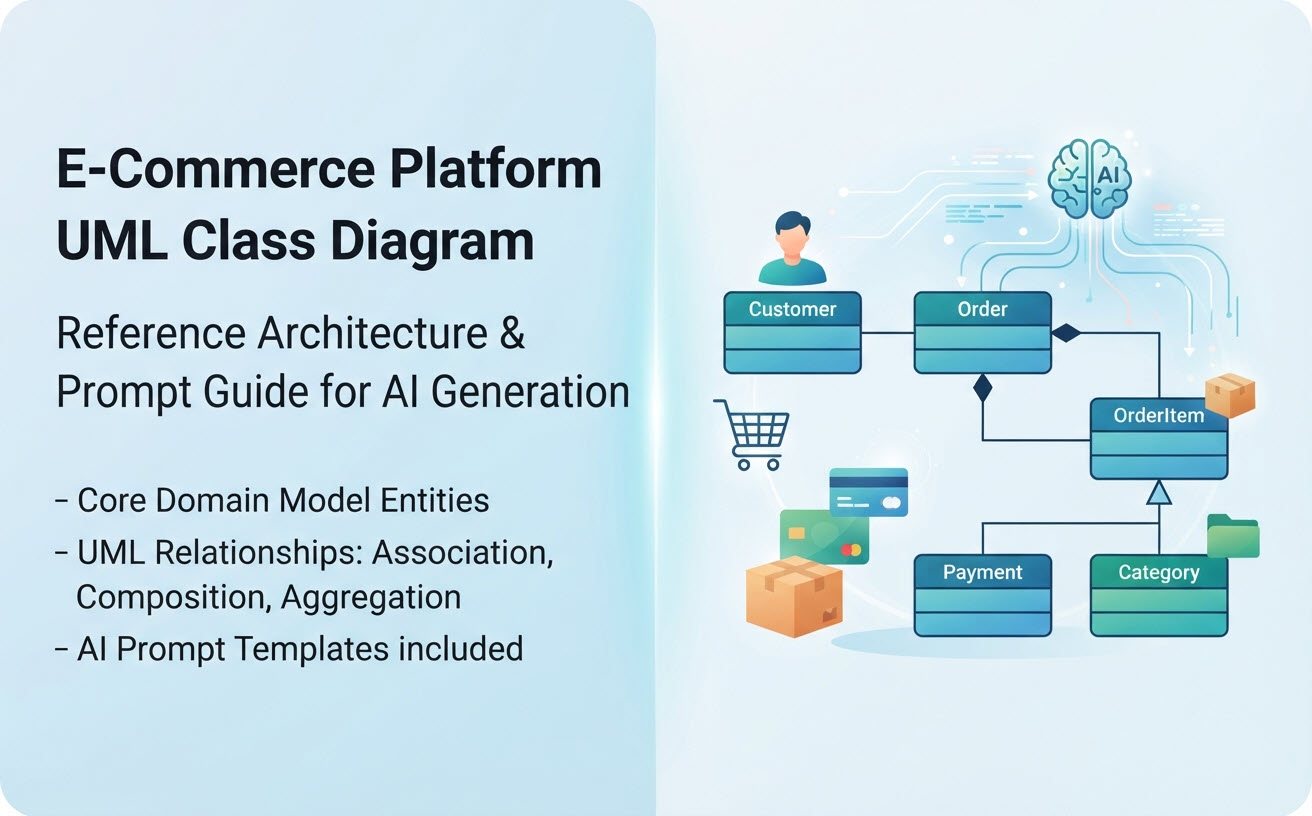
Designing an e-commerce platform requires a resilient object-oriented domain model capable of handling complex business transactions, inventory tracking, order lifecycles, and payment gateways. This reference architecture breaks down the core structural entities of a modern e-commerce backend and provides a ready-to-use guide for generating custom class models with an AI class diagram generator.
Key Subsystems in an E-Commerce Domain Model
An enterprise e-commerce system spans multiple interacting domain boundaries. To maintain modularity and clear separation of concerns, the UML class model is divided into four primary subsystems:
- User & Authentication Subsystem: Manages accounts, profiles, addresses, and customer/admin roles.
- Product & Inventory Subsystem: Tracks product catalogs, SKUs, categories, inventory stock, and pricing models.
- Order & Cart Subsystem: Captures active shopping sessions, line items, order status workflows, and discounts.
- Payment & Fulfillment Subsystem: Processes transactions, payment methods, shipping details, and invoice generation.
Core Classes and UML Relationships
A robust e-commerce class model relies on distinct UML relationship types to enforce business logic and lifecycle rules directly within the design:
1. Customer and Order (Association / Multiplicity)
A Customer class connects to an Order class via a 1-to-many relationship (1 to 0..*). A single customer can place multiple orders over time, but each order belongs to exactly one customer account.
2. Order and OrderItem (Composition)
An Order consists of multiple OrderItem line items. This is a strict **Composition** relationship (represented by a filled diamond on the Order end). If an Order is deleted, its individual line items cannot exist independently and are destroyed along with it.
3. Product and OrderItem (Aggregation)
An OrderItem references a Product. This is an **Aggregation** relationship (hollow diamond). If an order or line item is deleted, the underlying Product entity remains intact in the catalog.
4. Payment Hierarchy (Generalization / Inheritance)
An abstract Payment class acts as a superclass with common attributes (such as paymentId, amount, and status). Concrete subclasses like CreditCardPayment, PayPalPayment, and CryptoPayment inherit from Payment using **Generalization**.
Prompt Guide: Generating E-Commerce Models with AI
Instead of manually drawing dozens of classes, attributes, and relationship lines, software architects can use natural language prompts to auto-generate class diagrams using conversational AI.
With the Visual Paradigm AI Diagramming Chatbot, you can copy and adapt the prompt templates below to build instant architecture skeletons.
Template 1: Full E-Commerce Platform Prompt
“Generate a detailed UML Class Diagram for an e-commerce backend platform. Include the following classes: Customer, Address, Product, Category, ShoppingCart, CartItem, Order, OrderItem, Payment, CreditCardPayment, and PayPalPayment. Show composition between Order and OrderItem, aggregation between Category and Product, and generalization for Payment subclasses. Include visibility identifiers, data types, and method signatures for placing orders and processing payments.”
Template 2: Inventory & Warehouse Refinement Prompt
“Refine the previous e-commerce diagram by adding a Warehouse and InventoryItem class. Connect Warehouse to InventoryItem with composition, and link InventoryItem to Product. Include methods for checkStock() and reorderThreshold().”
To learn more about how conversational modeling accelerates software engineering workflows, visit our dedicated AI Class Diagram Generator Feature Page.
Taking Your E-Commerce Architecture to Production
Generating an initial e-commerce class diagram using AI is an ideal starting point. Visual Paradigm provides an end-to-end toolchain to evolve your AI prompt into production code and technical documentation:
1. Build Data Dictionaries in OpenDocs
Export your generated classes straight to Visual Paradigm OpenDocs to automatically maintain living data dictionaries, specifying column types, validation rules, and business definitions for development teams.
2. Edit Model-as-Code in VPasCode
The AI Chatbot outputs declarative PlantUML and code-based diagrams. Take these outputs into VPasCode to touch-up your e-commerce domain structure directly in the diagram-as-code editor.
3. Collaborative Design Reviews in VP Online
Share your e-commerce architecture with product managers and developers using VP Online. Conduct virtual whiteboarding sessions and fine-tune entity relationships with an intuitive drag-and-drop editor.
4. Forward Code Generation in VP Desktop
Import your domain model into Visual Paradigm Desktop to unlock forward engineering. Auto-generate production-ready class skeletons in Java, C#, or C++, or reverse-engineer an existing e-commerce codebase to verify architectural compliance.