


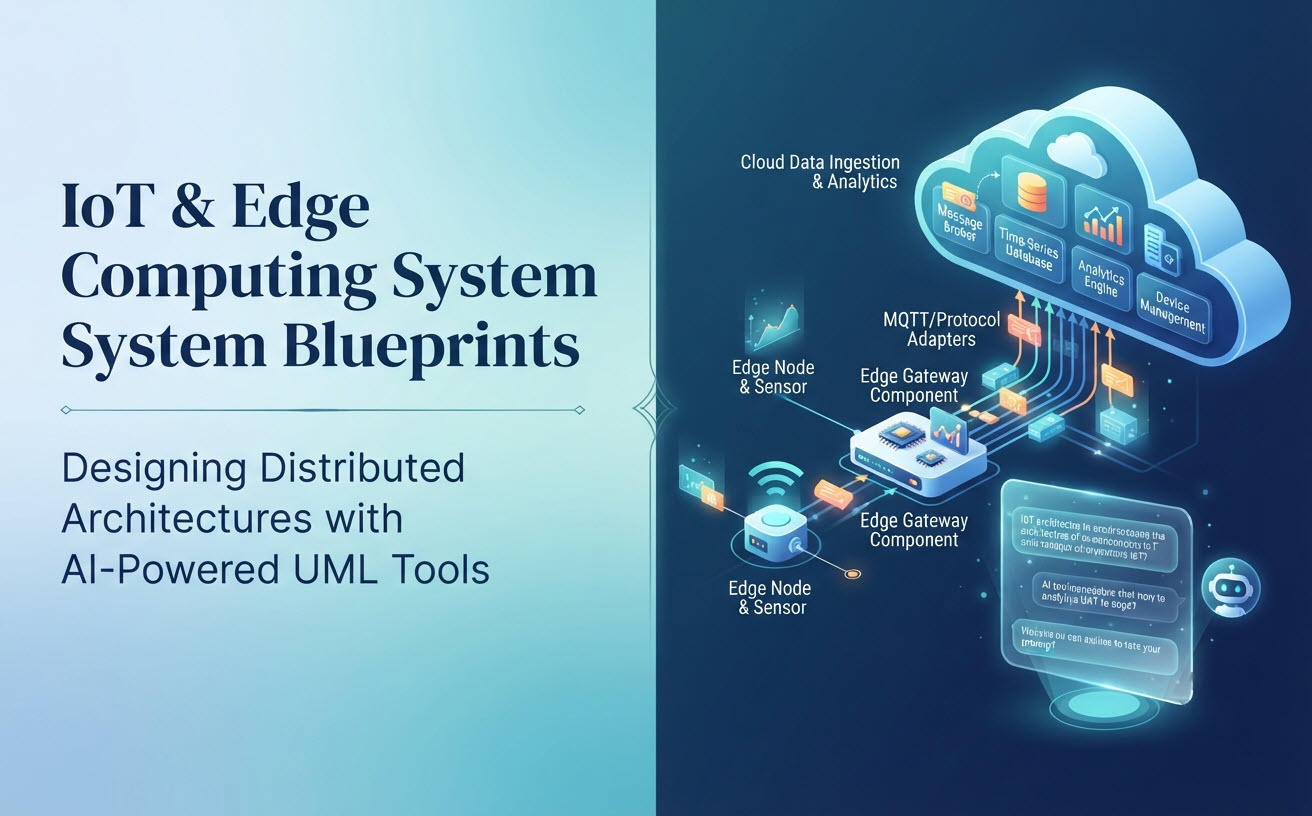
Internet of Things (IoT) and edge computing architectures bridge physical sensor networks with cloud-based analytics platforms. Managing hardware constraints, real-time local processing, and hybrid cloud synchronization requires strict structural clarity. UML Component Diagrams allow IoT systems architects to map sensor interfaces, edge gateway boundaries, MQTT data pipelines, and cloud analytics engines long before physical hardware deployment.
Core Layers in an IoT & Edge Computing System
A distributed edge-to-cloud IoT architecture decouples physical data collection from high-level intelligence across distinct logical layers:
- Edge Nodes & Sensor Layer: Low-power microcontrollers and physical sensors (temperature, pressure, motion) that collect telemetry and interface directly with physical environments.
- Edge Gateway Component: High-performance local devices that ingest raw sensor telemetry, execute low-latency rule engines, filter noise, and run local machine learning inference models near the data source.
- Communication & Protocol Adapters: Translates low-level industrial protocols (Modbus, OPC UA, BLE, Zigbee) into lightweight network protocols (MQTT, CoAP, HTTP/REST) for transit.
- Cloud Data Ingestion & Message Broker: Scalable message brokers (such as AWS IoT Core, Azure IoT Hub, or Apache Kafka) capable of securely ingesting millions of concurrent device events per second.
- Telemetry Processing & Analytics Engine: Processes incoming data streams for real-time alerting, long-term time-series storage, and predictive maintenance modeling.
- Device Management & Firmware Updates (OTA): Handles secure device provisioning, cryptographic key rotation, and Over-The-Air (OTA) firmware deployments.
Mapping Provided and Required Interfaces in IoT Systems
Because IoT architectures combine constrained embedded environments with cloud platforms, defining explicit provided and required interfaces prevents network bloat and integration failures:
- Sensor Protocols vs. Network Standards: The
Edge Gatewayexposes required interfaces (e.g.,ISensorDataIngest) to connect to diverse physical sensor outputs while providing standardized outbound MQTT interfaces to the cloud. - Store-and-Forward Buffering: When cloud connectivity drops, the local
Storage Buffer Componentat the edge provides an interface to hold telemetry locally until the required cloud broker interface becomes available again. - Edge Analytics Contracts: Machine learning inference models running locally expose provided interfaces for real-time anomaly detection, enabling immediate safety shutdowns without cloud round-trip latency.
Generating IoT Architectures with an AI UML Tool
Mapping complex hardware-software boundary interactions manually can be tedious. Leveraging an advanced AI UML tool allows IoT architects to generate, iterate, and document multi-tier edge-to-cloud blueprints using simple conversational prompts.
The Visual Paradigm AI Diagramming Chatbot—a core component of the Visual Paradigm AI Ecosystem—helps systems engineers quickly translate complex distributed architecture specs into clean, syntactically correct models.
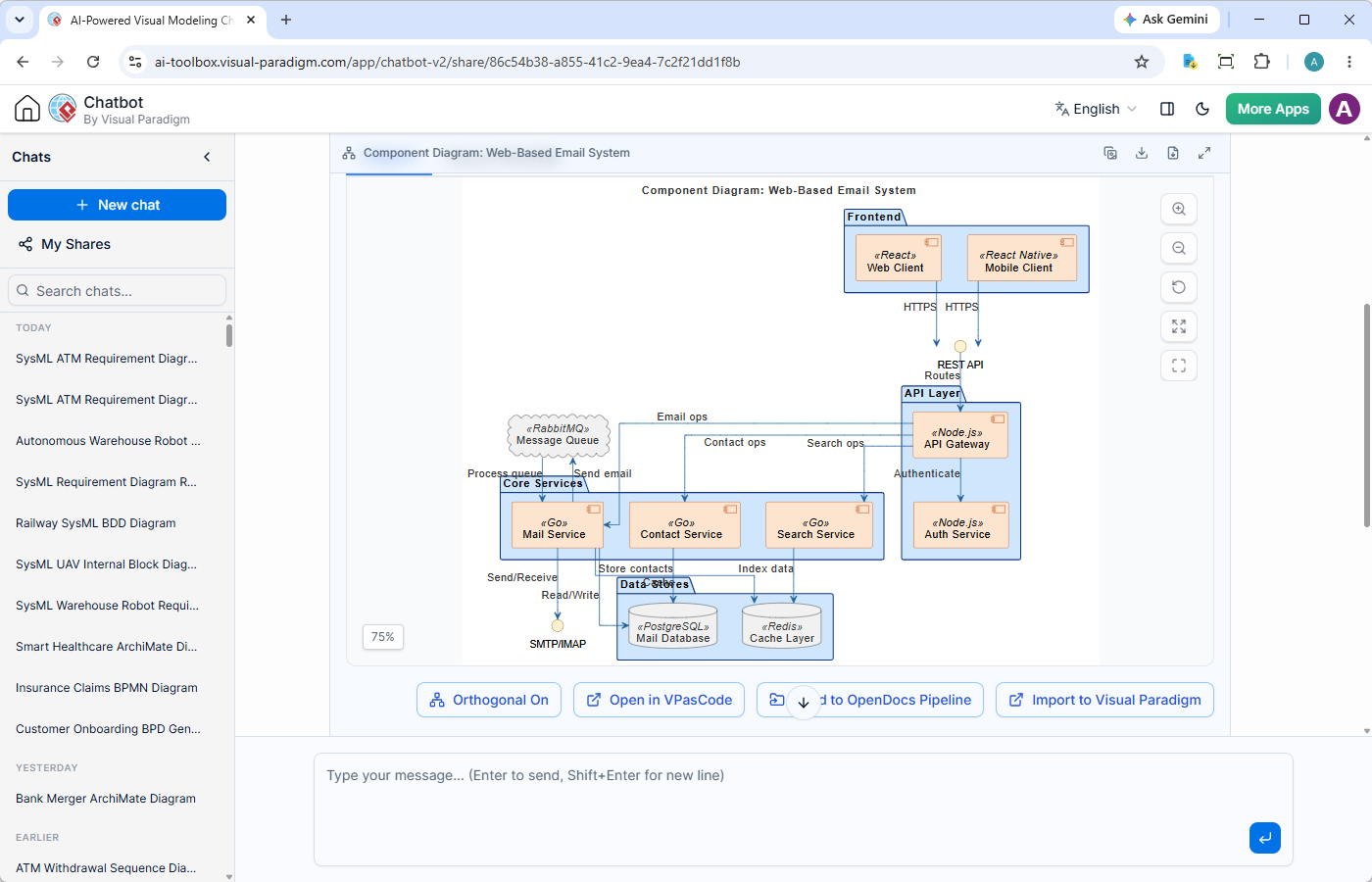
Example AI Prompts for IoT & Edge System Architecture:
- “Generate a UML component diagram for an industrial IoT system featuring Edge Sensors, an Edge Gateway with an MQTT Adapter, a Cloud Telemetry Ingestion Hub, and a Time-Series Database.”
- “Refine the diagram to add a local Anomaly Detection component on the Edge Gateway and show a Store-and-Forward local database buffer for offline resilience.”
- “Expand the cloud layer to separate real-time stream processing from long-term cold storage analytics and an OTA Firmware Update service.”
Key Chatbot Features for IoT Systems Engineers:
- Error-Free Generation: Uses a specialized AI model trained to produce syntactically valid UML models, ensuring valid interface connections and correct ball-and-socket assembly.
- Conversational Refinement: Rapidly adjust data processing boundaries, move workloads from cloud to edge, or add protocol converters simply by prompting the chatbot.
- Multi-Notation Flexibility: Complement component blueprints with behavioral workflows using built-in AI activity diagram tool features, sequence diagrams for MQTT handshakes, or deployment views for hardware nodes.
- Diagrams-as-Code Standards: Export portable text code (PlantUML, Mermaid, Graphviz) to store system blueprints alongside edge code repositories in Git.
Connecting IoT Blueprints to the Visual Paradigm Ecosystem
Visual Paradigm bridges the gap between conceptual edge architecture design and formal enterprise engineering documentation:
- Document Edge Contracts with OpenDocs: Export AI-generated component models directly to Visual Paradigm OpenDocs to publish clear sensor payload specs, interface contracts, and gateway integration guides.
- Minor touch-up via VPasCode: Edit textual diagram code in VPasCode.
- Collaborative Whiteboarding in VP Online: Share persistent chatbot session links or export models to VP Online for real-time design reviews with hardware, software, and cloud teams.
- Traceability in VP Desktop: Import component blueprints into Visual Paradigm Desktop to link high-level system components directly to concrete code packages, physical hardware deployment nodes, and class structures.
Build Your IoT Architecture Today
Accelerate your edge computing and IoT system design workflow with AI-driven component modeling. Test the Visual Paradigm AI Diagramming Chatbot with a free trial.
Full access is included with both VP Online Deluxe Edition and VP Desktop Professional Edition licenses.
Related Links
- Visual Paradigm VPasCode interactive playground: Try out Visual Paradigm VPasCode in the VPasCode interactive playground
- VPasCode overview: Learn more about VPasCode
- Try out Visual Paradigm AI Diagramming Chatbot: Generate diagrams with AI
- AI Diagramming Chatbot Overview: Learn more about AI Diagramming Chatbot: AI Diagramming Chatbot