


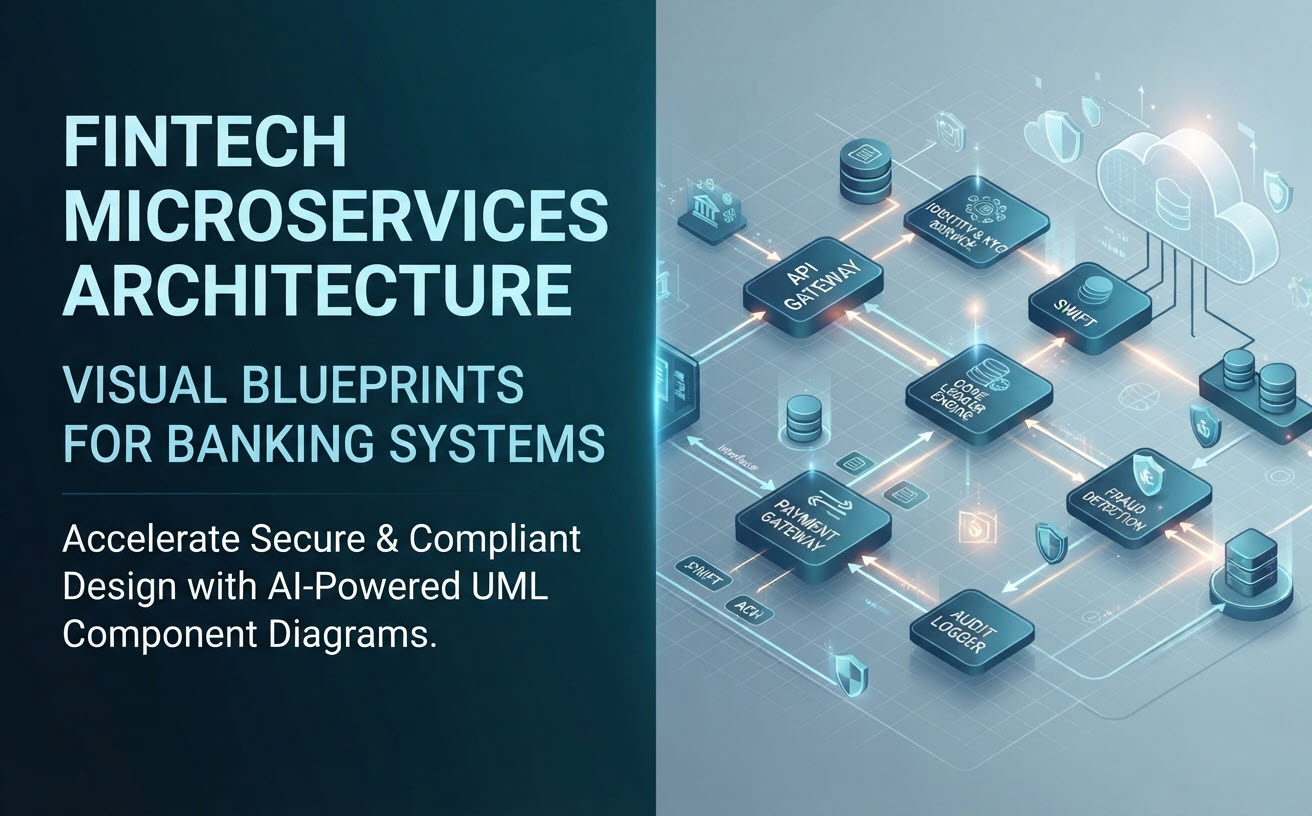
Financial technology platforms demand strict security, high availability, regulatory compliance, and seamless third-party integrations. As banking platforms shift from legacy mainframes to modern microservices architectures, visual blueprints become essential. UML Component Diagrams help software architects map secure service boundaries, audit logs, ledger databases, and compliance interfaces before deploying code to production.
Core Subsystems in a Fintech Microservices Architecture
A resilient banking or fintech platform relies on decoupled microservices designed to isolate sensitive financial operations and maintain strict data integrity. Key architectural components include:
- API Gateway & Authentication Service: Serves as the single entry point for web, mobile, and open banking API requests. Handles OAuth2/JWT token validation, rate limiting, and mTLS security terminating.
- KYC & Identity Verification Service: Manages customer onboarding, document scanning, and third-party identity verification API integrations (e.g., identity checks, sanction list screening).
- Core Ledger & Account Management Engine: Maintains double-entry accounting ledgers, account balances, and immutable transaction histories with strict ACID compliance.
- Payment & Settlement Gateway Component: Abstracts integrations with external banking rails (SWIFT, ACH, SEPA, FedNow) and card payment networks via standardized provided and required interfaces.
- Fraud Detection & Risk Engine: Evaluates incoming transactions in real-time using asynchronous event streaming to flag suspicious activities before settlement.
- Audit & Regulatory Compliance Logger: Captures tamper-proof activity logs required for PCI-DSS, SOC 2, and open banking compliance audits.
Mapping Provided and Required Interfaces in Banking Systems
Fintech architectures rely heavily on strict interface segregation to enforce security policies and prevent unauthorized data access between microservices:
- Payment Gateway Interfaces: The
Transfer Enginerelies on a required interface (e.g.,IPaymentRail) that plugs into provided interfaces exposed by specific payment rail adapters (e.g.,SWIFTAdapter,ACHAdapter). - Ledger Isolation: The core ledger exposes read-only provided interfaces for balance queries while restricting transactional updates behind secured, authenticated command interfaces.
- Asynchronous Event Streaming: High-throughput banking operations use event brokers (such as Kafka) to decouple real-time transaction processing from asynchronous risk analysis and audit logging services.
Generating Fintech Architecture Diagrams with an AI UML Tool
Designing secure banking architectures manually involves constant revisions as compliance requirements and integration contracts evolve. Utilizing an advanced AI UML tool allows software architects and senior engineers to draft, refine, and document complex financial systems using plain text prompts.
The Visual Paradigm AI Diagramming Chatbot—an integral part of the Visual Paradigm AI Ecosystem—helps engineering teams model enterprise microservices architectures with speed and precision.
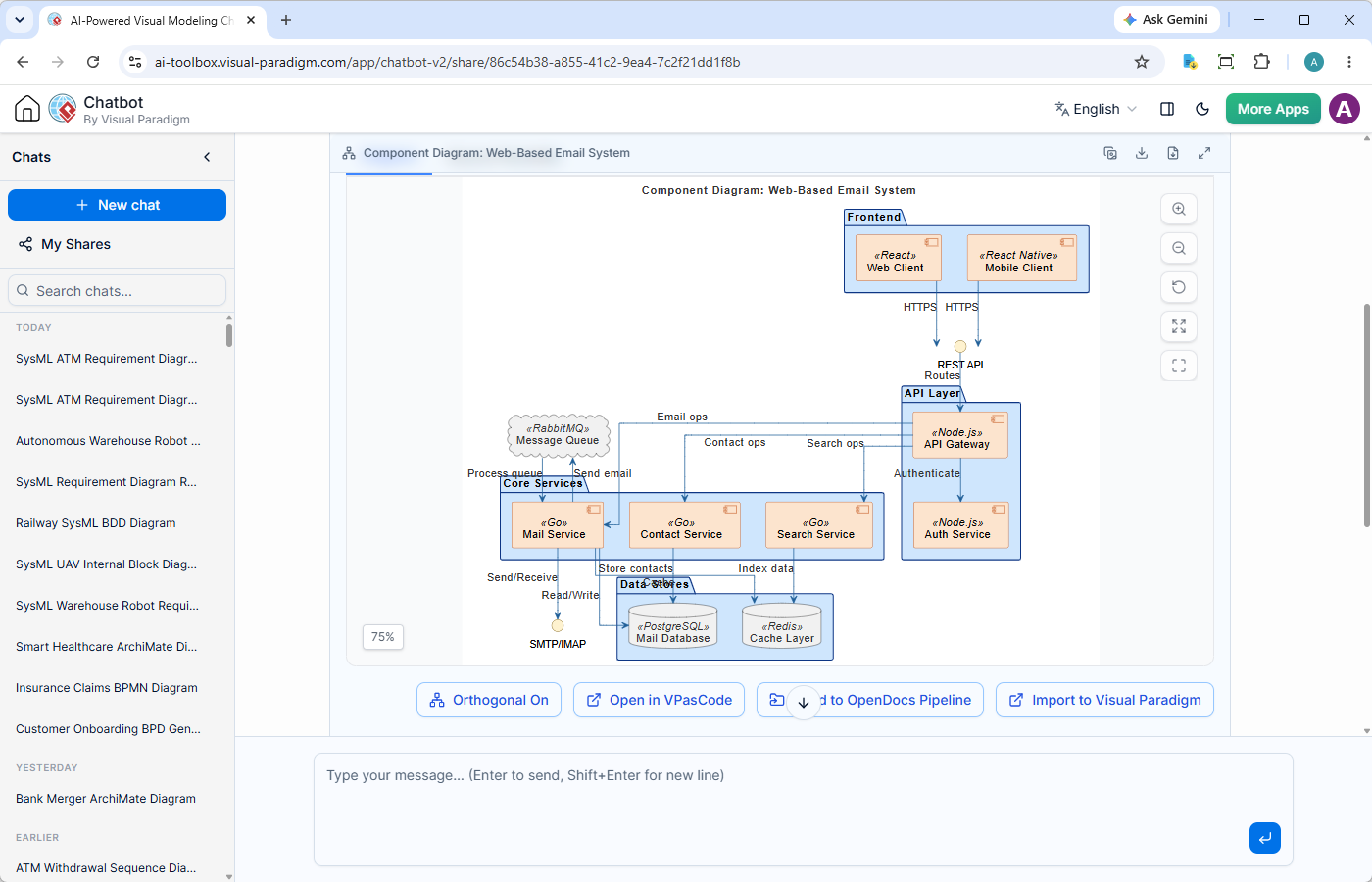
Example AI Prompts for Banking & Fintech Architecture:
- “Generate a UML component diagram for a digital banking system featuring an API Gateway, Auth Service, KYC Verification component, Core Ledger Service, and SWIFT payment adapter.”
- “Refine the diagram to add an asynchronous Fraud Detection Engine connected via a Kafka Event Broker, and isolate the Audit Log Service behind a dedicated database.”
- “Expand the Payment Adapter component to show provided and required interfaces for credit card processing, ACH clearing, and open banking APIs.”
Key Chatbot Features for Banking Systems Architects:
- High-Accuracy Engine: Powered by a specialized AI model trained to produce syntactically correct, error-free UML diagrams, avoiding illegal connections or broken interface links.
- Conversational Refinement: Modify security boundaries, split monolithic services, or add new integration endpoints simply by describing your requirements in natural language.
- Multi-Notation Support: Complement structural component views with behavioral flows using built-in AI activity diagram tool features, sequence generators, or C4 container models.
- Diagrams-as-Code Portability: All generated diagrams produce clean text code (PlantUML, Mermaid, Graphviz) that can be easily exported, version-controlled, and audited.
Integrating Banking Architecture into the Visual Paradigm Ecosystem
Visual Paradigm provides a unified software platform that connects high-level architectural ideation to enterprise governance and implementation:
- Compliance Documentation with OpenDocs: Export AI-generated component diagrams directly to Visual Paradigm OpenDocs to publish clear API contracts, interface definitions, and security specs for regulatory compliance reviews.
- Version Control via VPasCode: Manage textual diagram code directly inside VPasCode.
- Collaborative Whiteboarding in VP Online: Share persistent chat sessions or export architectural models to VP Online for real-time design reviews with distributed security and engineering teams.
- Traceability in VP Desktop: Import component blueprints into Visual Paradigm Desktop to link high-level system components directly to concrete implementation classes, database schemes, and deployment nodes.
Accelerate Your Fintech Architecture Design Today
Streamline your financial system design workflow with AI-driven component modeling. Test the Visual Paradigm AI Diagramming Chatbot with a free trial.
Full access is included with both VP Online Deluxe Edition and VP Desktop Professional Edition licenses.
Related Links
- Visual Paradigm VPasCode interactive playground: Try out Visual Paradigm VPasCode in the VPasCode interactive playground
- VPasCode overview: Learn more about VPasCode
- Try out Visual Paradigm AI Diagramming Chatbot: Generate diagrams with AI
- AI Diagramming Chatbot Overview: Learn more about AI Diagramming Chatbot: AI Diagramming Chatbot