


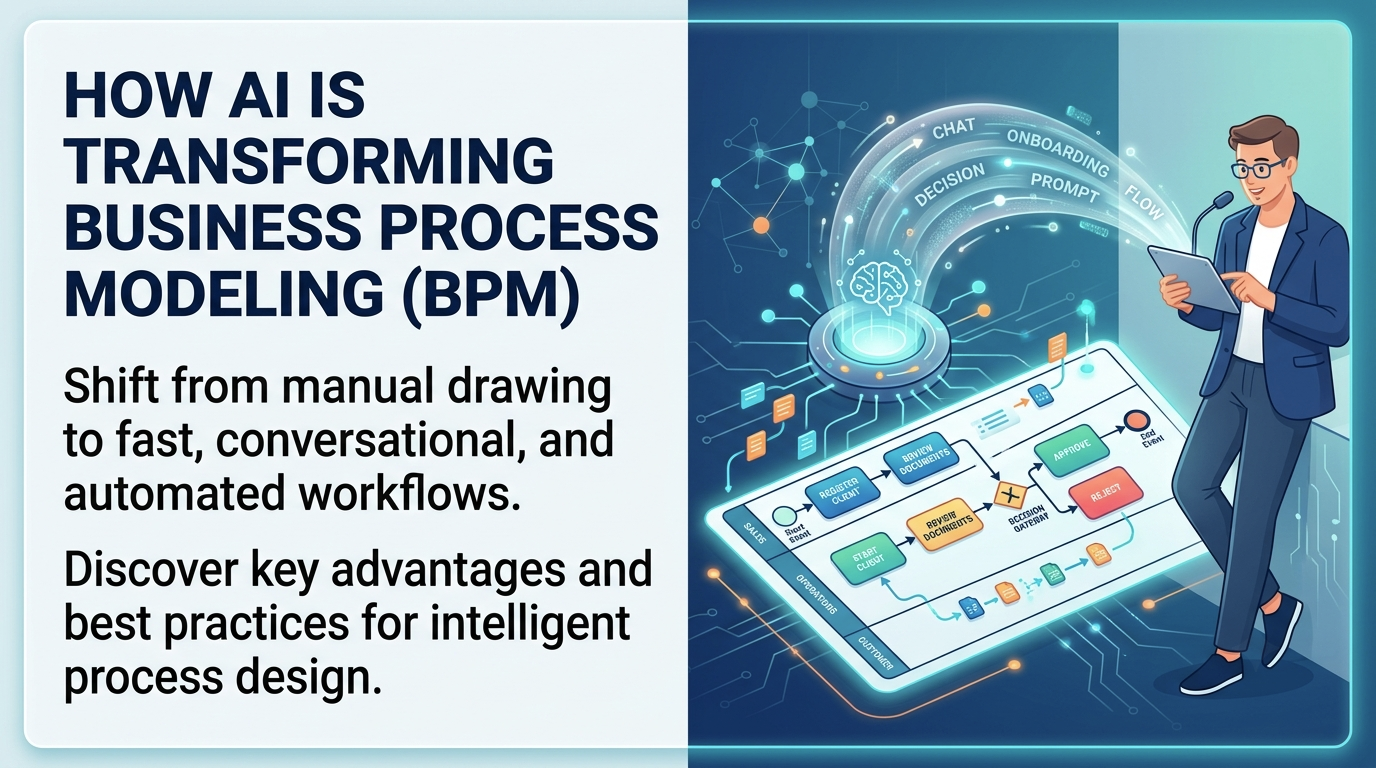
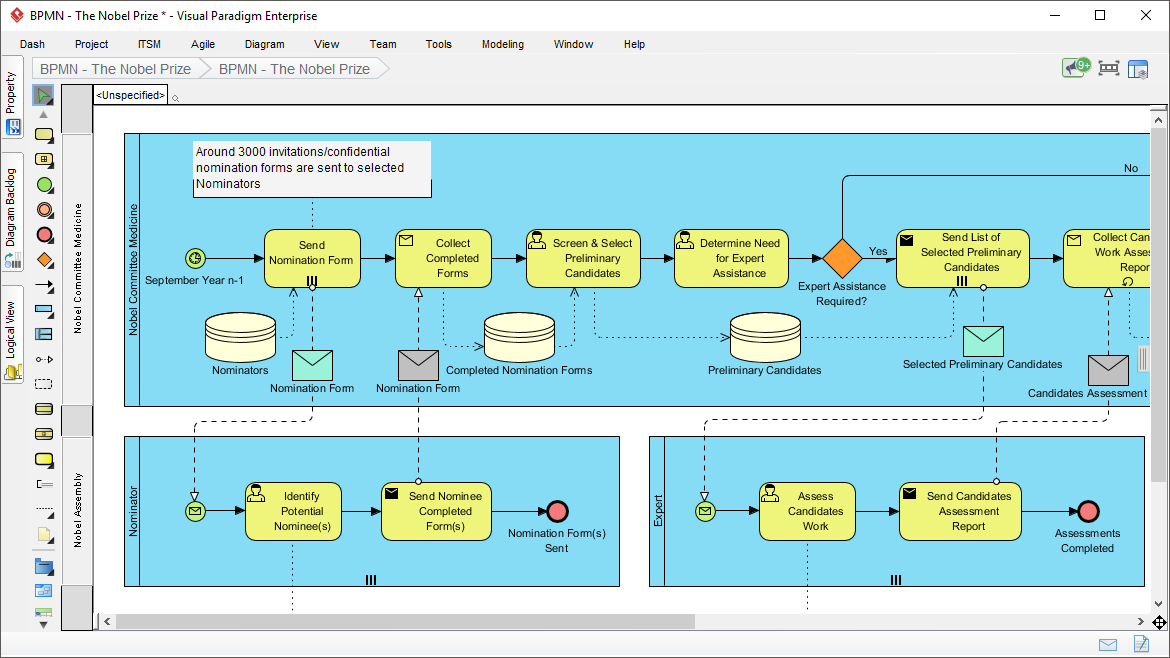
Business process modeling has long been a foundational discipline for operational efficiency. For decades, business analysts, enterprise architects, and project managers have spent countless hours interviewing stakeholders, mapping manual workflows, and meticulously drawing diagrams node-by-node. While the resulting Business Process Model and Notation (BPMN) diagrams provide crucial clarity, the process of creating them has traditionally been slow, labor-intensive, and prone to miscommunication.
The rise of Generative AI is changing this dynamic fundamentally. Artificial intelligence is shifting business process management (BPM) from a manual drawing exercise into a fast, conversational, and automated workflow. Understanding this transformation—and knowing how to leverage modern tools like Visual Paradigm‘s AI capabilities—is becoming essential for organizations seeking to maintain operational agility.
The Evolution from Manual Mapping to AI Generation with Visual Paradigm
Historically, modeling a business process required mastering complex notation standards. Teams had to manually select correct gateway types, establish swimlanes, and map event triggers. While standards like BPMN 2.0 brought much-needed rigor to process design, the steep learning curve often created a bottleneck between business ideas and visual documentation.
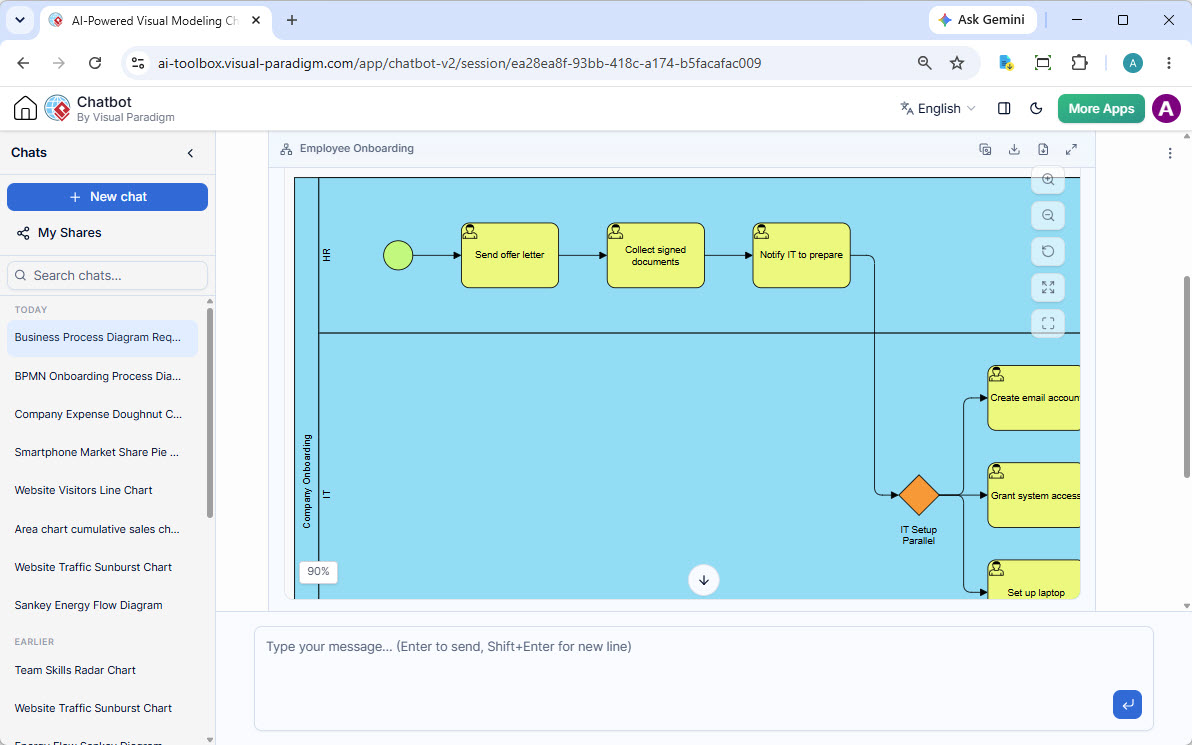
Visual Paradigm eliminates this entry friction by integrating Generative AI directly into its comprehensive modeling platform. Instead of starting with a blank canvas, analysts can now describe a business challenge or workflow in plain language within the Visual Paradigm interface. An intelligent engine interprets the narrative, identifies key roles and decision points, and constructs a structured BPMN diagram automatically.
By shifting from manual shape positioning to natural language prompt processing via Visual Paradigm, teams can move from problem definition to a visual baseline in minutes rather than days.
Key Advantages of Using Visual Paradigm’s AI BPMN Tool
Adopting an AI BPMN tool powered by Visual Paradigm introduces several operational advantages that extend beyond basic speed improvements:
- Rapid Prototyping: Instantly convert meeting transcripts, user stories, or policy documents into structured visual models during live discovery sessions using Visual Paradigm’s AI Chatbot.
- Reduced Human Error: Visual Paradigm’s AI models are trained on strict formal syntax, helping prevent common structural mistakes such as orphaned elements, misconfigured gateways, or broken sequence flows.
- Iterative Conversational Refinement: Rather than manually dragging elements to restructure a process, users can converse with the Visual Paradigm AI assistant to add sub-processes, introduce exception handling, or split paths effortlessly.
- Standardization Across Teams: A Visual Paradigm environment ensures consistent application of modeling conventions across different departments, preventing fragmented visual styles and ensuring compliance with enterprise standards.
Bridging Ideation and Enterprise Execution with Visual Paradigm
A common misconception is that AI diagramming is merely about generating quick static pictures. In an enterprise environment, a standalone diagram offers limited long-term value if it cannot be edited, maintained, or connected to downstream technical systems.
The real power emerges when an AI BPMN tool is integrated into a complete visual modeling ecosystem like Visual Paradigm. A generated diagram should serve as a dynamic starting point rather than a final artifact. Once the initial draft is created via Visual Paradigm’s AI, analysts need the ability to:
- Refine logic using drag-and-drop web or desktop editors native to the Visual Paradigm suite.
- Expand high-level tasks into detailed sub-process models without losing context.
- Maintain full traceability between business processes, system architectures, UML diagrams, and data models—all within a single Visual Paradigm project.
- Generate comprehensive documentation and publish interactive web portals for stakeholders directly from the model.
When choosing an enterprise-grade AI BPMN tool, it is vital to select a solution like Visual Paradigm that combines rapid prompt-based generation with mature, end-to-end modeling capabilities.
Best Practices for Implementing AI in Process Design with Visual Paradigm
To maximize the value of AI-assisted process modeling within your organization, consider the following strategic guidelines:
1. Provide Clear Context in Prompts
When feeding text into the Visual Paradigm AI generator, include specific details about roles, inputs, decision criteria, and expected outputs. The clearer your descriptive narrative, the more accurate the resulting BPMN diagram will be within the Visual Paradigm editor.
2. Use AI for Drafts, Human Expertise for Validation
Treat AI generation as a highly efficient first draft. Subject matter experts (SMEs) should always review the generated workflows in Visual Paradigm to ensure domain-specific nuances, regulatory compliance, and business logic are accurately reflected before finalizing the model.
3. Integrate Process Models with Systems Architecture
Ensure that your process maps do not exist in isolation. Connect business-level BPMN models directly with underlying system software components, database schemas, and organizational roles using Visual Paradigm’s integrated architecture features to maintain full enterprise alignment.
Frequently Asked Questions
What is an AI BPMN tool?
An AI BPMN tool is software that leverages artificial intelligence to automatically translate text descriptions of business workflows into standardized Business Process Model and Notation (BPMN) diagrams. Visual Paradigm accelerates process documentation and simplifies iterative workflow design through its advanced AI integration.
Can AI completely replace human business analysts?
No. AI acts as an accelerator that handles routine drawing, syntax checking, and initial drafting. Human analysts remain essential for stakeholder negotiation, strategic problem alignment, edge-case validation, and change management. Tools like Visual Paradigm empower analysts to focus on these high-value activities rather than manual diagramming.
Are AI-generated BPMN diagrams fully editable?
Yes, provided you use an AI BPMN tool built on an editable visual modeling framework. Leading platforms like Visual Paradigm allow you to edit generated diagrams conversationally or open them in drag-and-drop canvas editors for advanced customization, ensuring your AI drafts become production-ready models.
Conclusion
Generative AI is fundamentally changing how business processes are documented, analyzed, and optimized. By removing technical barriers to entry and accelerating initial drafting, organizations can focus their energy on strategy and execution rather than manual drawing. Adopting a dedicated AI BPMN tool like Visual Paradigm within a comprehensive modeling platform empowers business and IT teams to collaborate seamlessly and engineer better operational outcomes.