


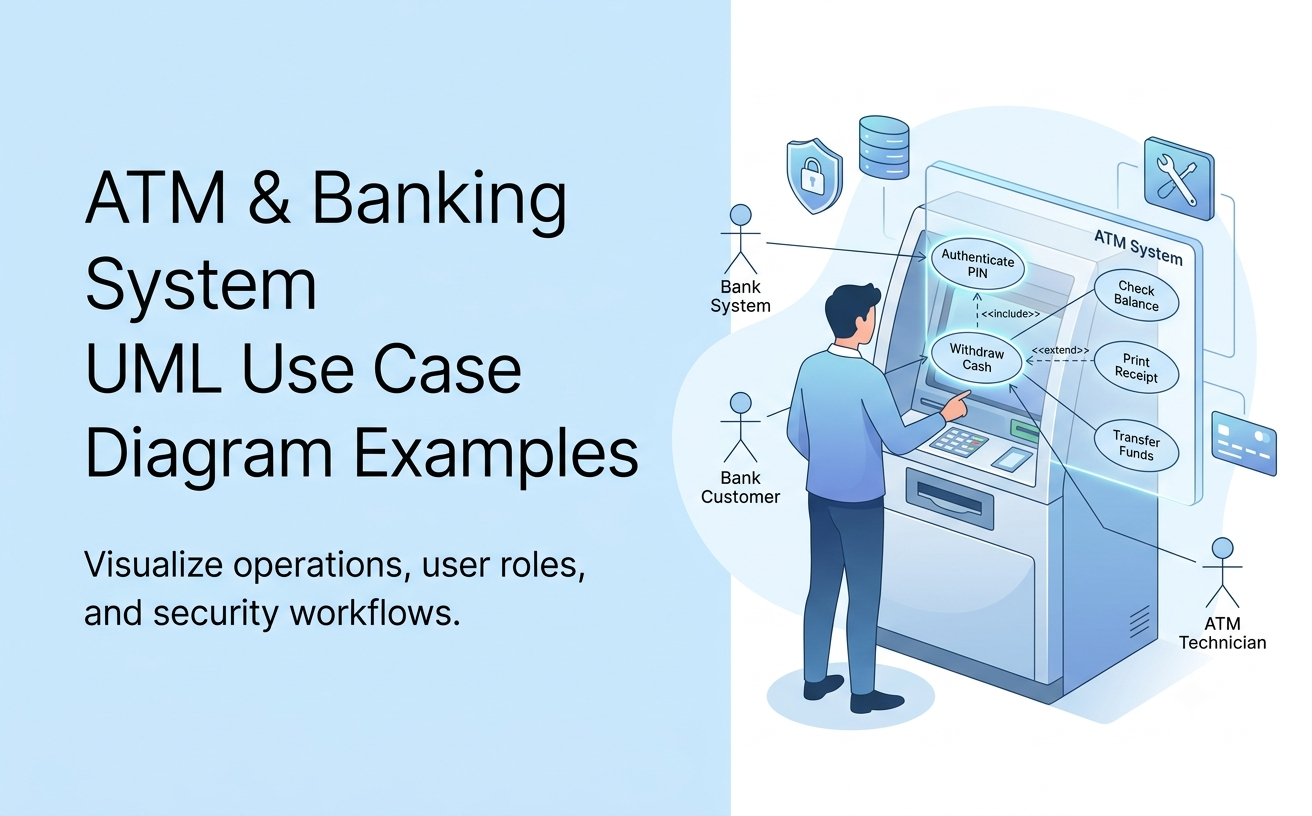
Automated Teller Machine (ATM) and banking systems are classic benchmarks in software architecture and systems analysis. Because financial transactions require strict security, real-time balance checks, and fault-tolerant operations, creating a precise UML Use Case Diagram is critical for establishing clear system boundaries and operational rules.
In this guide, we analyze standard banking and ATM use case models, detail actor responsibilities, provide copy-and-paste AI prompts, and demonstrate how to convert complex transactional workflows into formal diagrams using conversational AI.
Core Actors in Banking & ATM Systems
Financial software models strictly separate human operations from backend verification services and physical maintenance roles:
- Bank Customer: The primary end-user interacting with the ATM hardware to conduct financial operations like cash withdrawals, balance inquiries, and funds transfers.
- ATM Technician / Operator: Internal personnel responsible for servicing the physical ATM hardware (e.g., refilling cash cashboxes, replenishing receipt paper, running diagnostic checks).
- Bank Information System (External Network): The central banking database and authorization server that verifies accounts, validates PINs, and records ledger transactions.
Primary Use Cases & Relationships
Banking use cases heavily rely on mandatory inclusion for security checks and extension relationships for conditional events such as insufficient funds or receipt generation:
| Use Case | Primary Actor | Relationship Type | Description |
|---|---|---|---|
Withdraw Cash |
Bank Customer | Includes Authenticate PIN |
Primary transactional flow allowing customers to dispense funds from their account. |
Authenticate PIN |
Bank Information System | Included in core operations | Mandatory security step required before any account transaction is authorized. |
Print Receipt |
Bank Customer | Extends Withdraw Cash / Transfer Funds |
Optional physical output offered to the customer upon transaction completion. |
Replenish Cash Box |
ATM Technician | Base Use Case | Administrative task to refill cash reserves and update internal hardware counters. |
Complete ATM System Use Case Diagram Example
The following structural model illustrates the boundary between the physical ATM terminal, external users, maintenance technicians, and central banking backend servers:
Figure 1: High-level UML use case diagram for an Automated Teller Machine (ATM) System.
Ready-to-Use AI Chatbot Prompts
You can instantly generate and refine financial models using Visual Paradigm’s AI Diagramming Chatbot. Paste any of these prompts to start modeling:
Prompt 1: Baseline ATM System Model
Generate a UML use case diagram for an ATM System. Include Bank Customer, ATM Technician, and Bank Backend System as actors. Model use cases for Withdraw Cash, Check Balance, Transfer Funds, Authenticate PIN, Print Receipt, and Refill Cash. Show <<include>> for PIN authentication and <<extend>> for receipt printing.Prompt 2: Exception & Fraud Handling Refinement
Refine the ATM diagram to include exception scenarios. Add "Flag Card as Stolen" as an extension of "Authenticate PIN" and "Handle Card Retain" when three invalid PIN attempts occur.Diagram-as-Code (PlantUML / Mermaid)
Visual Paradigm’s AI Chatbot generates human-readable code representations (such as PlantUML or Mermaid), enabling version management and direct text editing:
@startuml
left to right direction
actor "Bank Customer" as Customer
actor "ATM Technician" as Tech
actor "Bank Backend System" as Bank

rectangle "ATM System" {
  usecase "Withdraw Cash" as UC_Withdraw
  usecase "Check Balance" as UC_Balance
  usecase "Authenticate PIN" as UC_Auth
  usecase "Print Receipt" as UC_Receipt
  usecase "Refill Cash Box" as UC_Refill

  Customer --> UC_Withdraw
  Customer --> UC_Balance
  Tech --> UC_Refill

  UC_Withdraw .> UC_Auth : <<include>>
  UC_Balance .> UC_Auth : <<include>>
  UC_Receipt .> UC_Withdraw : <<extend>>

  UC_Auth --> Bank
}
@endumlEvolving Financial Models in Visual Paradigm
Because financial applications demand rigorous verification and trace-ability, Visual Paradigm provides an end-to-end ecosystem to transition AI ideation into formal architectural documentation:
- Web Generation: Create initial financial models instantly on our AI Diagramming Chatbot.
- Code Precision with VPasCode: Fine-tune underlying PlantUML or Mermaid syntax in VPasCode to update transaction logic quickly.
- Visual Refinement in VP Online: Export diagrams to Visual Paradigm Online for visual formatting, alignment, and executive presentations.
- Deep Architectural Modeling in VP Desktop: Import your ATM diagrams into Visual Paradigm Desktop to map use cases directly to sequence models, state machine diagrams, and requirement matrices for full audit readiness.
- Living Specifications with OpenDocs: Publish detailed banking specifications using Visual Paradigm OpenDocs to maintain synchronized documentation across compliance and development teams.
Frequently Asked Questions
How does the AI handle security and authorization sub-flows in UML?
The AI Chatbot correctly models authorization checks (such as Authenticate PIN or Biometric Verification) as included use cases required by primary transactional goals like cash withdrawal or funds transfer.
Can I expand an ATM use case into state or activity diagrams?
Yes. By importing your AI-generated diagram into Visual Paradigm Desktop, you can right-click any use case oval (such as Withdraw Cash) to automatically construct detailed activity diagrams or state machine flows for hardware integration.
What licenses include AI banking diagram generation features?
Full AI conversational diagramming is included with both VP Online Deluxe Edition and VP Desktop Professional Edition licenses.