Round-Trip Engineering: Keeping Visual Models and Source Code in Sync Through Forward and Reverse Engineering
The greatest risk to any modeling initiative is divergence: the beautiful, carefully crafted UML diagrams become outdated as soon as developers start typing code. Requirements change, shortcuts are taken, new patterns emerge, bugs force quick fixes—and within weeks or months, the model no longer reflects reality. This “model-code drift” turns architecture into shelfware and erodes trust in visual documentation.
Round-trip engineering solves this by establishing a bidirectional, living synchronization between the visual model and the actual source code. Visual Paradigm supports true round-trip for many popular languages and frameworks, allowing you to:
- Forward engineer — Generate or update source code from the model
- Reverse engineer — Import or update the model from existing source code
- Synchronize incrementally — Merge changes in either direction without overwriting valuable work
Combined with the AI-generated models from earlier modules, round-trip becomes a powerful mechanism for keeping architecture, design, and implementation continuously aligned—throughout agile sprints, refactoring campaigns, legacy modernization, or long-term maintenance.
How Round-Trip Engineering Works in Visual Paradigm
-
Forward Engineering (Model → Code) Starting from your AI-generated Class Diagram:
- Select Tools > Code > Generate Java/C++ Code.
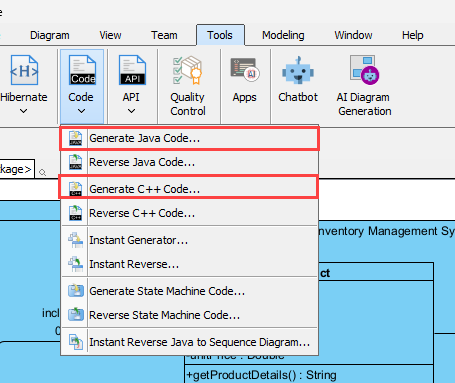
- Click OK to start generating code.
- Select Tools > Code > Generate Java/C++ Code.
-
Reverse Engineering (Code → Model) When code already exists (legacy system, teammate contributions, open-source libraries):
- Select Tools > Code > Reverse Java / C++ Code…
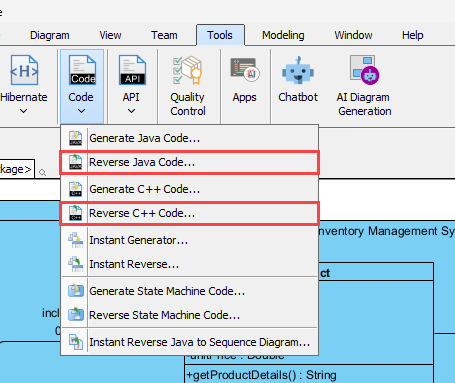
- Select source folder.
- Click OK. This will automatically creates or updates Class Diagrams from method calls (via code parsing)
- Select Tools > Code > Reverse Java / C++ Code…
-
Incremental Synchronization & Conflict Resolution The real power lies in ongoing sync:
- After developers add new features in code → reverse engineer → model updates appear (new classes, methods, relationships)
- After architects refactor the model (new interface, renamed operation) → forward engineer → code updates (merge mode preserves handwritten logic)
Why Round-Trip Succeeds Where Others Fail
| Common Model-Code Drift Problems | Visual Paradigm Round-Trip Advantages |
|---|---|
| One-way generation → model becomes outdated | True bidirectional sync (forward + reverse) |
| Generated code overwritten by hand | Merge mode preserves handwritten logic during forward |
| Teams abandon modeling after first sprint | Continuous sync makes model a living reference |
Practical Workflow Tips
- Agile teams: Reverse after each sprint → update model → AI critique → forward missing architectural improvements
- Architecture governance: Enforce “model is source of truth” → forward changes to code → reject direct code edits that break sync
Real-World Impact
- Living Documentation — Architecture stays accurate even as code evolves
- Faster Refactoring — Refactor safely in model → regenerate → implement details
- Reduced Technical Debt — Early detection of drift via reverse + critique
- Team Alignment — Developers trust the model because it reflects reality
Round-trip engineering transforms the model from a static blueprint into a dynamic, self-updating contract between architecture and implementation. Combined with code generation and team collaboration features, your AI-powered modeling environment now fully supports the entire professional software lifecycle—from initial vision to long-term evolution.
This completes Module 8 and the entire course. You now possess a complete, modern, AI-augmented workflow that turns natural language into production-grade, globally accessible, continuously synchronized software architecture. Thank you for joining this journey—your models are now ready to power real systems, real teams, and real business outcomes.