

Foundations of Agile Modeling with UML 2.5
Welcome to the foundational module of this hands-on UML course, where we blend the power of UML 2.5 with Agile principles to create lightweight, effective modeling practices that drive real project success. In today’s fast-paced software development world, modeling isn’t about producing massive documentation—it’s about simplifying complexity, enabling better communication, and reducing risks early through visual thinking.
The Importance of Modeling: Simplifying Reality to Master Complex Systems
At its core, a model is a purposeful simplification (or abstraction) of reality. It strips away unnecessary details to help teams understand, communicate, and reason about a system more effectively. Without modeling, complex software projects often lead to misunderstandings, rework, and costly surprises.
Practical examples of why modeling matters:
- E-commerce platform development — Without a high-level class diagram or domain model, developers might implement duplicate shopping cart logic in different modules, leading to inconsistencies (e.g., one team applies discounts before taxes, another after). A simple UML class diagram quickly reveals shared concepts like Order, CartItem, and PricingRule, preventing this drift.
- Mobile banking app — A sequence diagram can illustrate the authentication flow across user, app, API gateway, and backend services. This visual exposes potential security gaps (like missing token validation steps) before any code is written, saving weeks of refactoring.
- Microservices migration — Teams modeling component and deployment diagrams early can spot tight coupling between services (e.g., shared databases causing cascading failures), allowing them to redesign boundaries iteratively rather than discovering issues in production.
- Legacy system modernization — Reverse engineering a messy codebase into UML class and package diagrams helps new developers onboard quickly—often reducing ramp-up time from months to weeks by providing a “big picture” map.
- Stakeholder alignment in Agile sprints — A quick use case overview or activity diagram during sprint planning clarifies “what” the system should do from the user’s view, reducing scope creep and ensuring the team builds the right thing.
In Agile contexts, models are “just barely good enough”—sketched on whiteboards, digital tools, or simple diagrams—to facilitate discussion, validate assumptions, and guide implementation without becoming outdated artifacts.
Principles of Agile Modeling
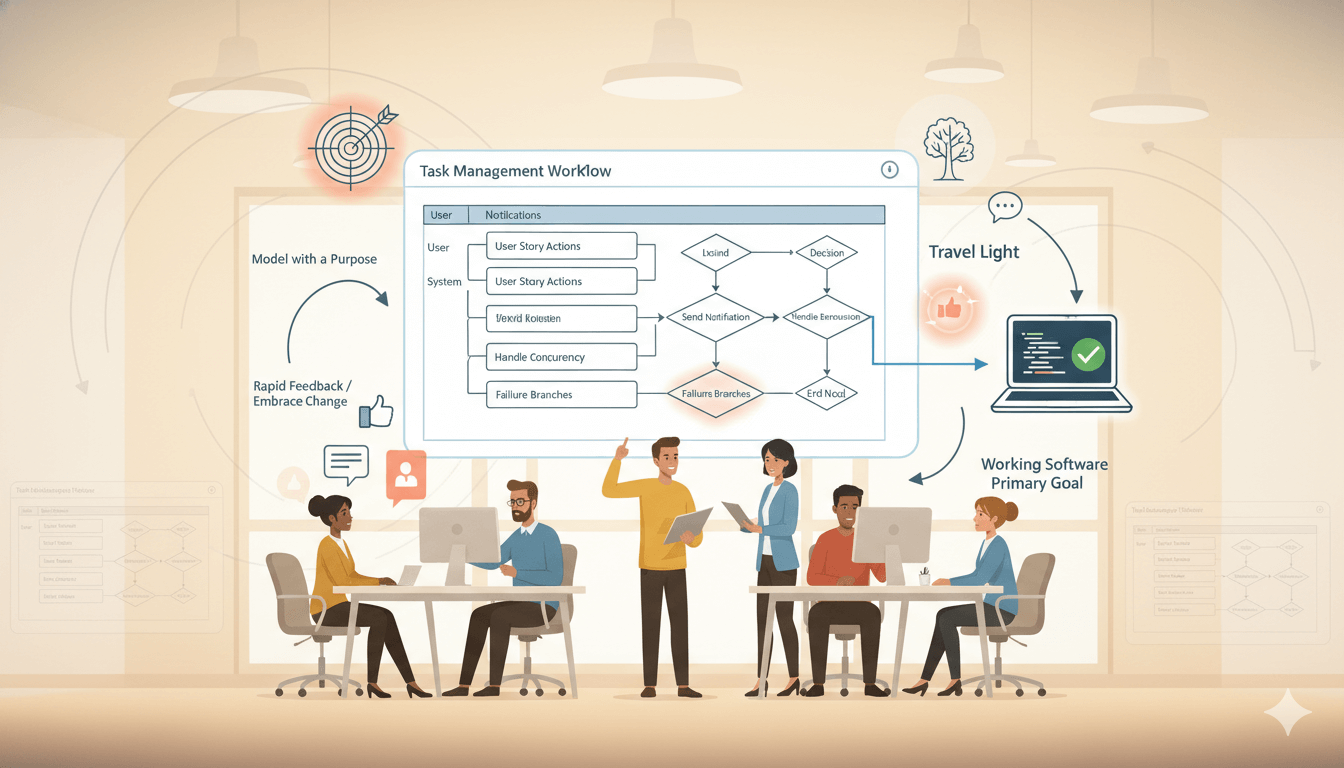
Agile Modeling (inspired by Scott Ambler’s work) adapts modeling to fit iterative, risk-driven, and feedback-heavy Agile environments. Key principles include:
- Model with a Purpose — Every model or diagram exists to answer a specific question (e.g., “How does the payment flow handle failures?”). Avoid “big design up front.”
- Maximize Stakeholder ROI — Focus effort on high-value models that reduce project risks or clarify requirements.
- Travel Light — Keep models minimal and discard them when they no longer add value.
- Multiple Models — Use the right diagram for the job—no single view suffices for everything.
- Rapid Feedback — Share models early and often with stakeholders for quick validation.
- Assume Simplicity — Start with the simplest explanation; embrace change when needed.
- Embrace Change — Models evolve iteratively alongside code.
- Working Software Is the Primary Goal — Modeling supports delivery, not replaces it.
Practical application example: In a Scrum team building a task management app, the team models only the critical user story workflow (activity diagram) in Sprint 0 to attack risks around notifications and concurrency. They avoid over-modeling unrelated admin features, revisiting diagrams only when feedback reveals gaps.
UML 2.5 Overview
UML 2.5 provides a standardized visual language with 14 diagram types, built from three core building blocks:
- Things — Basic elements like classes, actors, use cases, nodes, etc.
- Relationships — Connections such as associations, generalizations, dependencies, realizations.
- Diagrams — Views that organize things and relationships for specific purposes.
The 14 diagrams split into structural (static) and behavioral (dynamic):
- Structural (7): Class, Object, Package, Component, Composite Structure, Deployment, Profile.
- Behavioral (7): Use Case, Activity, State Machine, Sequence, Communication, Interaction Overview, Timing.
Practical examples:
- Use a class diagram to model domain entities in an inventory system (Product, Warehouse, StockLevel).
- A sequence diagram shows message flow in a real-time chat feature.
- A deployment diagram maps app containers to cloud nodes for scalability planning.
Practical: Agile Setup in Visual Paradigm
Visual Paradigm excels as an AI-enhanced, visual modeling platform that supports Agile workflows through iterative releases and the semantic backplane (a unified model repository where all elements live, ensuring consistency across diagrams).
By the end of this module, you’ll appreciate modeling as a lightweight, risk-reducing tool that fits perfectly into Agile’s iterative rhythm. You’ll be ready to dive into use case-driven requirements in Module 2, using Visual Paradigm to build and evolve models collaboratively.