

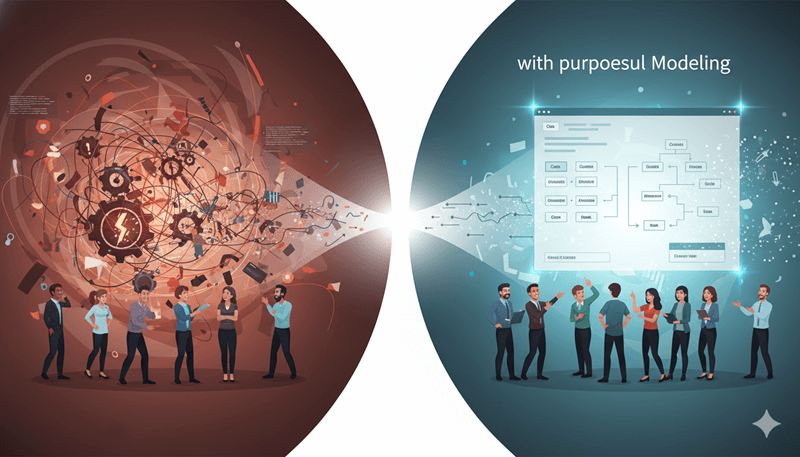
Understanding models as a simplification of reality to better grasp complex systems.
Modeling lies at the heart of effective software development, especially in Agile environments where speed, collaboration, and risk reduction are paramount. A model is fundamentally a purposeful abstraction—a deliberate simplification of reality that strips away irrelevant details while preserving the essential aspects needed to understand, communicate, design, and evolve a system. By creating these simplified representations, teams can reason about complexity without drowning in it, spot issues early, align stakeholders, and guide implementation more reliably.
In practice, modeling turns intangible ideas into tangible visuals that everyone—from developers to product owners to non-technical stakeholders—can discuss and refine. Without modeling, complex systems often lead to misunderstandings, duplicated effort, technical debt, and expensive rework. With modeling (especially lightweight, Agile-friendly UML), teams attack risks head-on, validate assumptions quickly, and deliver higher-quality software iteratively.
Here are many practical, real-world-inspired examples demonstrating why modeling matters:
- E-commerce checkout flow in a high-traffic online store A team building a new payment module sketches a simple sequence diagram showing interactions between User → Shopping Cart → Payment Gateway → Order Service → Bank API. Without this model, developers might overlook edge cases like network timeouts or partial refunds. The diagram reveals a missing retry mechanism early, preventing production failures during peak sales (e.g., Black Friday), where a small oversight could cost thousands in lost revenue.
- Mobile banking app authentication and session management Modeling the login workflow with an activity diagram (including swimlanes for User, App, API Gateway, Auth Service, and Fraud Detection) highlights potential security vulnerabilities, such as missing multi-factor fallback or token expiration handling. Spotting these risks during sprint planning—rather than in a security audit after deployment—saves significant refactoring and avoids regulatory fines or user trust erosion.
- Microservices-based inventory system for a retail chain Early component and deployment diagrams show tight coupling via a shared database between Order Service and Inventory Service. The visual immediately flags scalability and failure isolation risks (one service outage cascades to others). The team redesigns boundaries (e.g., event-driven communication) before coding begins, reducing deployment risks and enabling independent scaling—critical when holiday demand spikes.
- Legacy monolithic ERP system modernization Reverse-engineering parts of a 15-year-old codebase into class and package diagrams creates a “big picture” map for new developers. Instead of months reading code to understand domain concepts (e.g., Customer, Invoice, Payment terms), a clean domain model diagram accelerates onboarding from months to weeks, cuts knowledge-transfer risks, and prevents accidental breakage during incremental refactoring.
- Healthcare appointment scheduling platform A use case diagram and accompanying flow of events documentation clarifies actor interactions (Patient, Doctor, Admin, Notification Service) and boundary conditions. During stakeholder reviews, the business discovers an overlooked requirement: handling no-shows with automated rescheduling. Modeling catches this gap before implementation, avoiding scope creep mid-sprint and ensuring compliance with patient privacy regulations.
- Real-time collaboration tool (like a shared whiteboard app)Communication diagrams illustrate message flows between clients and server for concurrency (multiple users drawing simultaneously). The model exposes race conditions in shape locking early. Fixing the design in diagrams is far cheaper than debugging live synchronization bugs after launch, where poor UX could drive users to competitors.
- Agile sprint planning for a task management SaaS In Sprint 0 (or Inception), the team draws a lightweight activity diagram for the core “Create & Assign Task” workflow. It quickly surfaces ambiguities (e.g., who receives notifications? What happens on reassignment?). Clarifying these with stakeholders reduces mid-sprint requirement changes, keeps velocity high, and prevents “working on the wrong thing”—a common Agile failure mode.
- Financial trading platform handling high-frequency ordersTiming diagrams model strict time constraints on order matching and execution. Visualizing latency budgets and state transitions helps identify performance risks (e.g., exceeding regulatory reporting deadlines). Addressing these in models prevents costly production incidents where milliseconds matter.
- Cross-team alignment in distributed development Business stakeholders don’t read code, but they understand use case diagrams showing actor goals and system boundaries. A simple diagram bridges the gap between “what the business wants” and “what developers build,” reducing miscommunication that often leads to 30–50% rework in traditional projects.
- Onboarding new team members mid-project A maintained set of class diagrams (domain model) and sequence diagrams (key interactions) acts as living documentation. New hires grasp the system’s vocabulary and flow in days instead of weeks, lowering bus-factor risks and enabling faster contributions in short sprints.
In Agile contexts, modeling follows the “travel light” and “model with a purpose” principles: diagrams are quick sketches (often digital whiteboards or Visual Paradigm), created just-in-time, validated with stakeholders, and evolved or discarded as needed. They aren’t heavy documentation—they’re communication tools that make complexity manageable.
By embracing modeling as simplification, teams don’t just build software faster—they build the right software with fewer surprises, lower risk, and better collaboration. This sets the stage for the use-case-driven approach we’ll explore next, where models directly drive requirements and design in an iterative, feedback-rich way.