

Chapter 1: Understanding ArchiMate
This opening chapter serves as your essential entry point into ArchiMate, the open and independent enterprise architecture modeling language maintained by The Open Group. Designed specifically for describing, analyzing, and visualizing the complex relationships across an organization’s business domains, IT systems, and technical infrastructure, ArchiMate acts as a common “language” that brings clarity to enterprise architecture (EA) discussions.
In a world where businesses must continuously align strategy with execution, manage digital transformation, and respond to rapid change, ArchiMate provides the precision needed to bridge the gap between high-level vision and operational reality. It enables architects, business leaders, IT teams, and other stakeholders to communicate unambiguously—avoiding the misunderstandings that often arise from using ad-hoc diagrams, free-form sketches, or overly detailed technical notations.
Core Purpose and Role in Enterprise Architecture
ArchiMate is not just another diagramming tool; it is a standardized, vendor-independent modeling language that supports the full spectrum of EA concerns—from strategic motivations and capabilities down to physical infrastructure and migration roadmaps. Its primary goal is to help stakeholders:
- Describe how the enterprise is constructed and operates
- Analyze the impacts of proposed changes
- Visualize interconnections across domains in a consistent way
This makes it an ideal complement to frameworks like TOGAF, where ArchiMate serves as the go-to notation for creating architecture deliverables.
Key Benefits of Adopting ArchiMate
ArchiMate stands out for its focused, lean design and powerful advantages:
- Precision and Unambiguity — Every element, relationship, and viewpoint follows strict rules, reducing misinterpretation.
- Vendor Independence — As an open standard, it works seamlessly across tools (including Visual Paradigm’s certified ArchiMate 3.2 environment featured throughout this course).
- Holistic Coverage — It models the entire enterprise from strategy and motivation to business processes, applications, technology, and physical elements.
- Improved Communication — Stakeholders from different backgrounds can quickly understand models thanks to intuitive notation and consistent layering.
The latest version, ArchiMate 3.2 (with refinements released in recent years), enhances clarity through improved concept definitions (e.g., for outcomes, constraints, and products), a more flexible Technology Layer metamodel (better support for physical elements and composition/aggregation), and expanded derivation rules—making models even more expressive without adding complexity.
Practical Examples to Bring ArchiMate to Life
To illustrate why ArchiMate matters, here are a few simple, real-world scenarios modeled with the language:
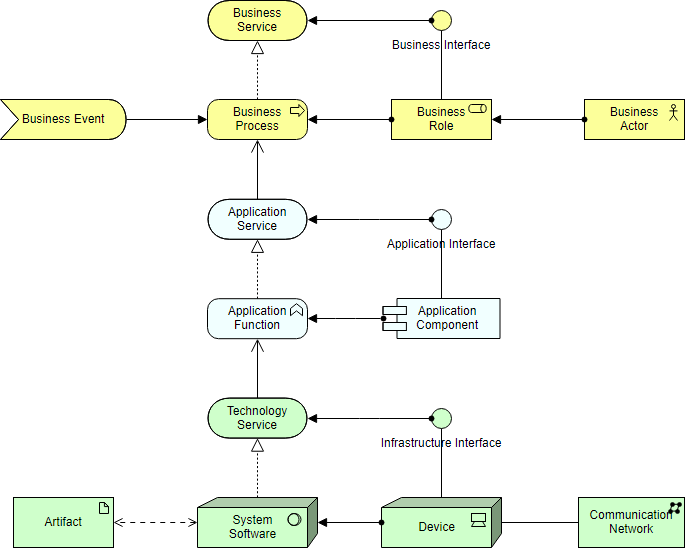
- Business-IT Alignment in Retail Imagine a retail company wanting to launch an online store. An ArchiMate Layered Viewpoint can show how a new Business Service (“Online Shopping”) is realized by Application Components (e.g., e-commerce platform) that run on Technology Nodes (cloud servers). This single diagram reveals dependencies and helps assess the impact of moving to a new cloud provider.
Here are some visual examples of layered ArchiMate models that demonstrate this cross-layer clarity:
- Digital Transformation – As-Is vs. To-Be A bank migrating to digital channels can use motivation and realization relationships to model how a Driver (“Customer Demand for Mobile Banking”) leads to Goals and Requirements, which are realized by new Business Processes and supporting Application Services.
- Simple Stakeholder View An insurance company can create a basic Organization Viewpoint showing Business Actors (e.g., Claims Adjuster) assigned to Business Roles that perform Business Functions supported by applications—perfect for onboarding discussions or compliance reviews.
Here’s a classic layered viewpoint example with actors, processes, services, and technology:
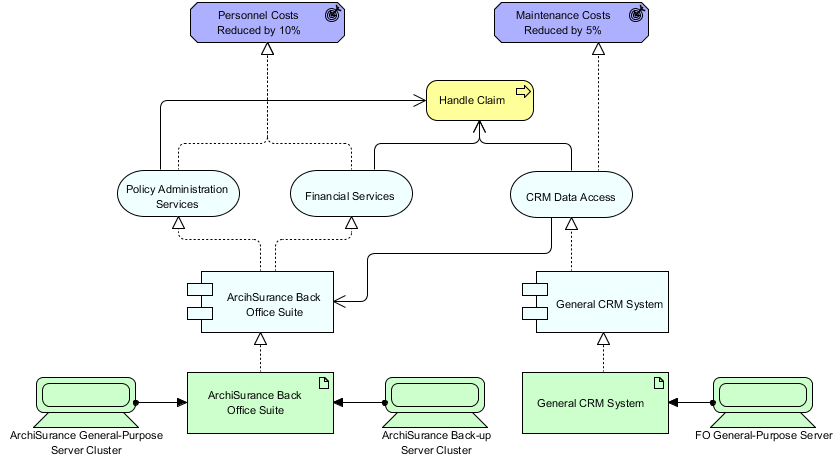
These examples highlight how ArchiMate turns abstract enterprise concerns into clear, traceable models—something we’ll build on throughout the course using Visual Paradigm’s drag-and-drop interface and AI-powered diagram generation.
By the end of this chapter, you’ll grasp why ArchiMate has become the de facto standard for modern enterprise architecture modeling, and you’ll be ready to dive into hands-on creation in the chapters ahead. Let’s start speaking the same architectural language!