


Tired of manual schema mapping and normalization headaches? Visual Paradigm’s AI-powered database design app, DB Modeler AI, redefines the architecture workflow by converting simple business descriptions into production-ready SQL. Unlike generic drawing tools, this professional online database modeler guides you through a rigorous 7-step transformation process. It’s not just about aesthetics; it’s about engineering integrity, from conceptual domain models to interactive schema testing in a live playground environment!
Most tools on the market leave you with a static image and a “good luck” wish. DB Modeler AI acts as your personal database architect, ensuring your database schema follows best practices from the first click to the final report. Let’s dive into how this tool beats the competition by automating the most tedious parts of backend development.
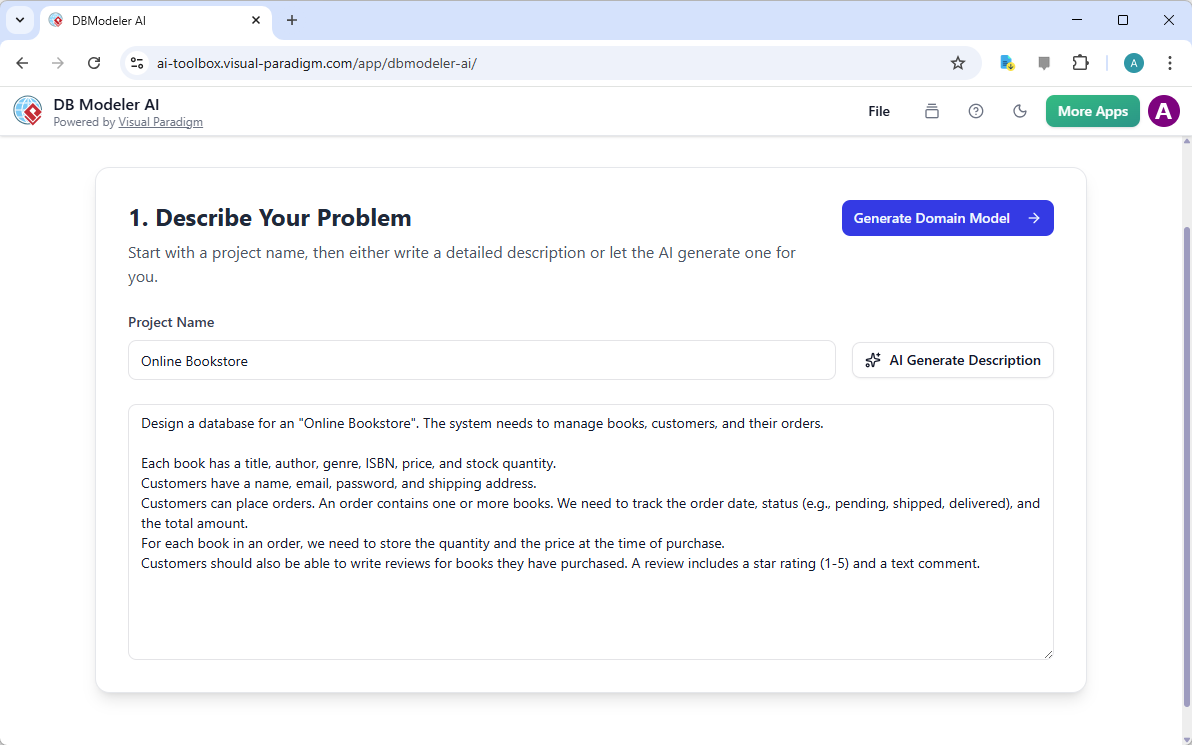
Step 1 begins with the “Problem Input.” In the example of an Online Bookstore, you don’t need to be a technical writer. You simply provide the project name, and the AI drafts a comprehensive description covering books, customers, orders, and reviews. This sets a solid foundation for the logic that follows.
Why This Is the Best Professional Database Modeler
In a market saturated with basic “text-to-diagram” bots, Visual Paradigm stands out by offering a structured, multi-stage pipeline. Here is why it is superior:
-
Guided Logic: It doesn’t just jump to SQL; it builds conceptual understanding first through Domain Class Diagrams.
-
Normalization Expertise: It automatically refines your data into 3NF (Third Normal Form), preventing data redundancy.
-
Live Validation: The unique “Playground” allows you to “taste” your database before deploying a single line of code to production.
-
Bridge the Gap: It translates vague business needs into precise technical artifacts, perfect for stakeholders and developers alike.
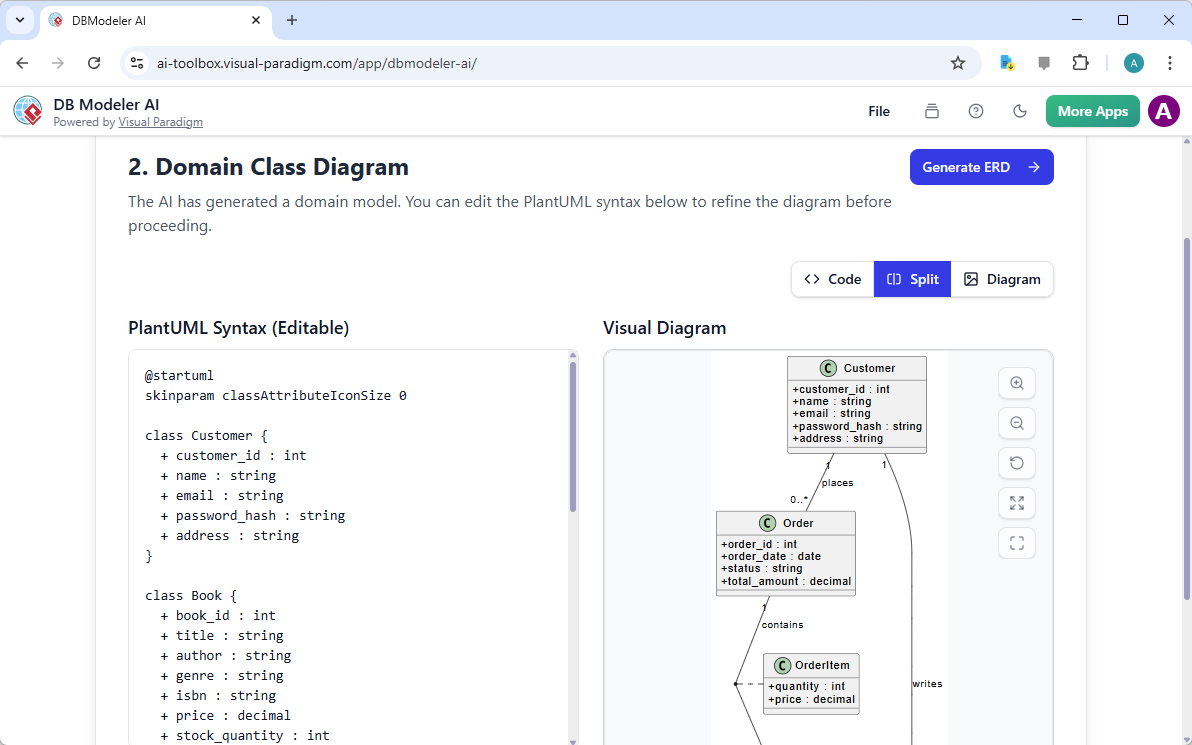
Once your problem is defined, Step 2 generates a Domain Class Diagram. This visualizes business entities like “Customer” and “Order” and their relationships. The tool provides the PlantUML syntax alongside a clean visual diagram, allowing for instant manual refinements if the AI missed a specific business nuance.
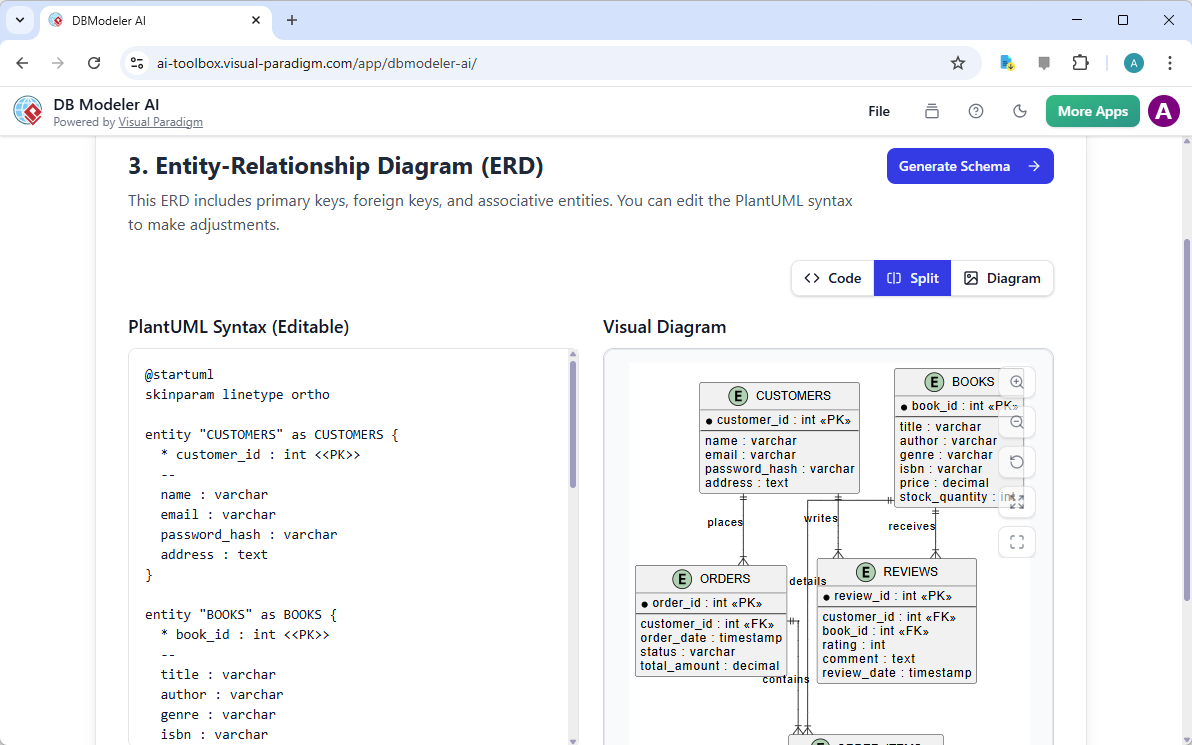
From the conceptual model, the AI-powered database design app moves to Step 3: the Entity-Relationship Diagram (ERD). This is where things get technical! The ERD identifies primary keys, foreign keys, and associative entities. It’s the blueprint of your data’s physical existence, presented with professional clarity that far exceeds basic whiteboard tools.
Automating the Heavy Lifting: SQL and Normalization
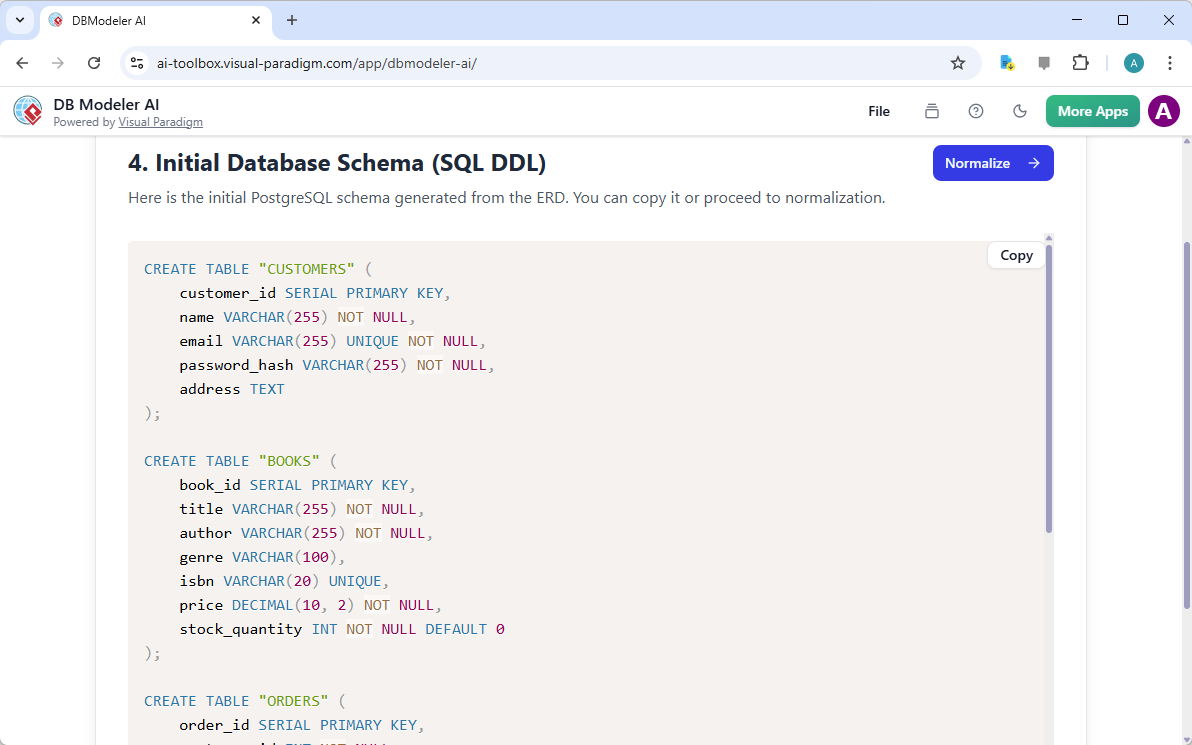
The real magic happens when you transition from diagrams to code. Step 4 generates the Initial Database Schema (SQL DDL). In our bookstore example, the AI creates PostgreSQL-compatible scripts for tables like CUSTOMERS and BOOKS, including data types like SERIAL, VARCHAR, and DECIMAL. No more syntax errors or forgotten constraints!
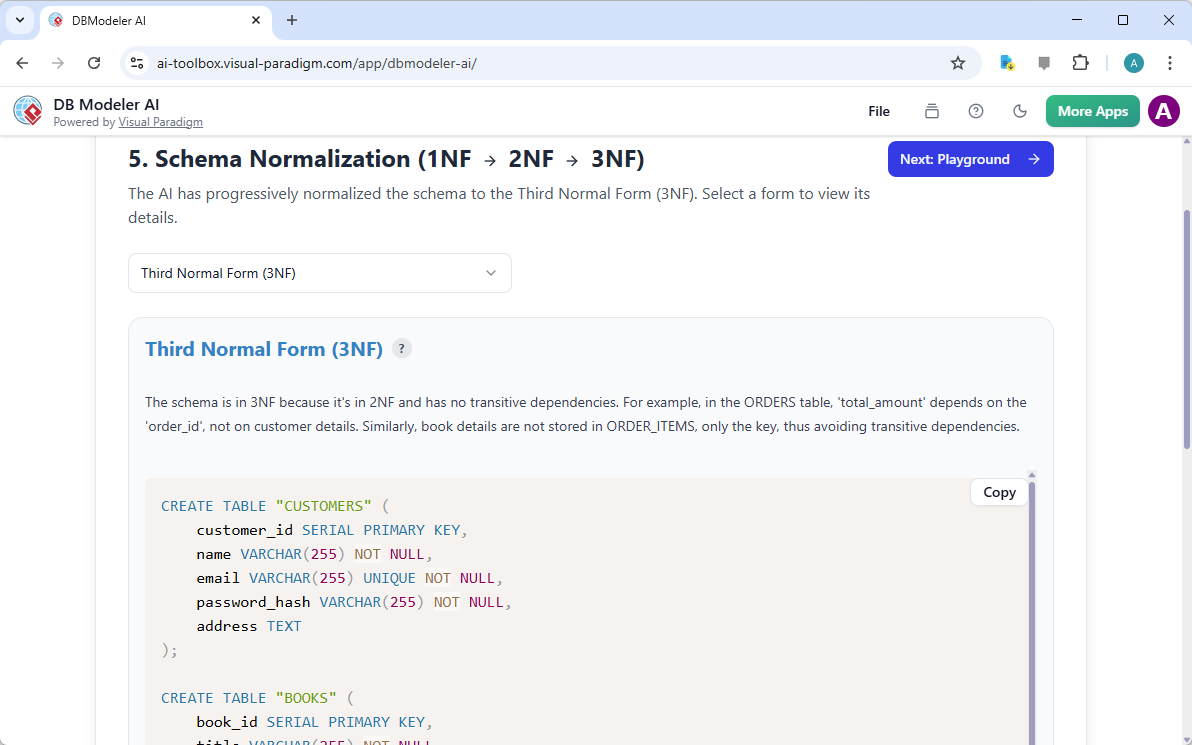
However, an initial schema isn’t always an efficient one. This is where most AI tools fail, but DB Modeler AI excels. Step 5 provides Normalization Assistance, progressively moving your schema from 1NF to 3NF. It explains the “why” behind the changes—such as removing transitive dependencies in the ORDERS table—ensuring your database is lean and scalable.
Key Takeaways for Database Professionals
-
Speed: Go from “Idea” to “SQL” in under five minutes.
-
Accuracy: AI-driven normalization reduces the risk of data anomalies.
-
Flexibility: Export projects as JSON or save to the cloud for seamless collaboration.
-
Education: Learn the database design process through a guided 7-step wizard.
The Killer Feature: Interactive Schema Playground
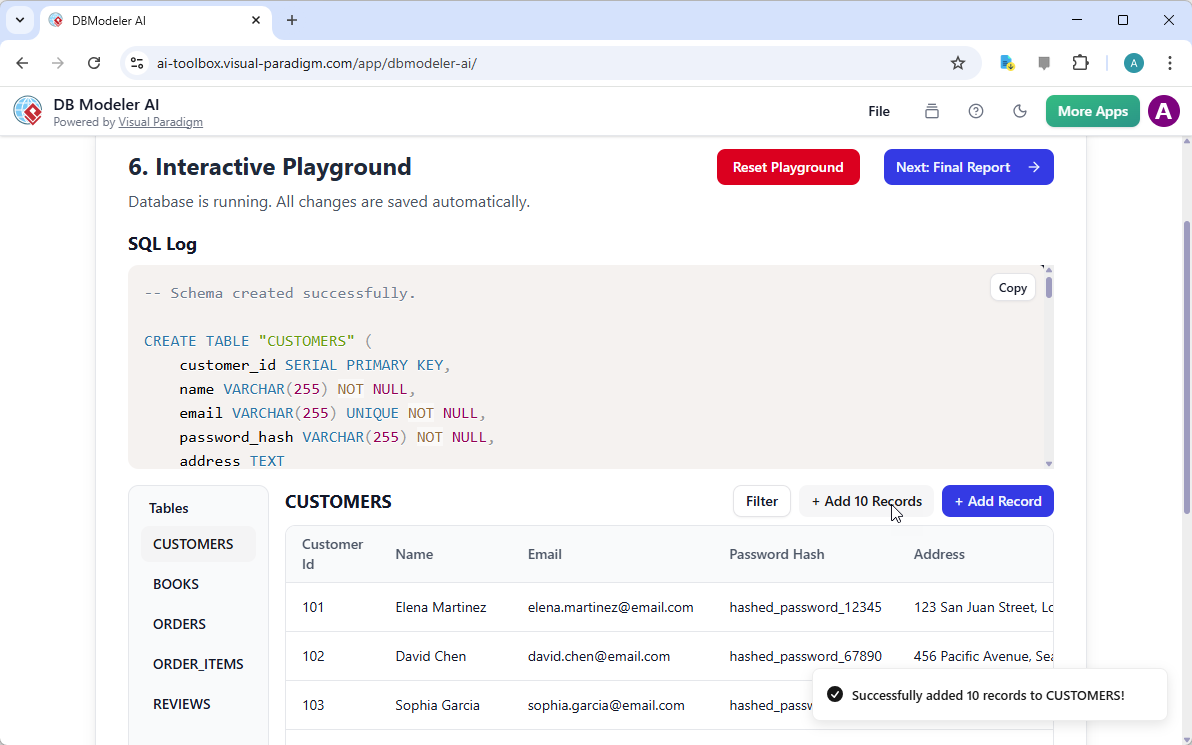
The industry’s biggest pain point is the “blind implementation” phase. You design a schema, build the app, and then realize the relationships are wrong. Visual Paradigm solves this with Step 6: The Interactive Playground. This is a simulated environment where the database is actually running! You can add records, filter data, and see the exact SQL statements executed behind the scenes.
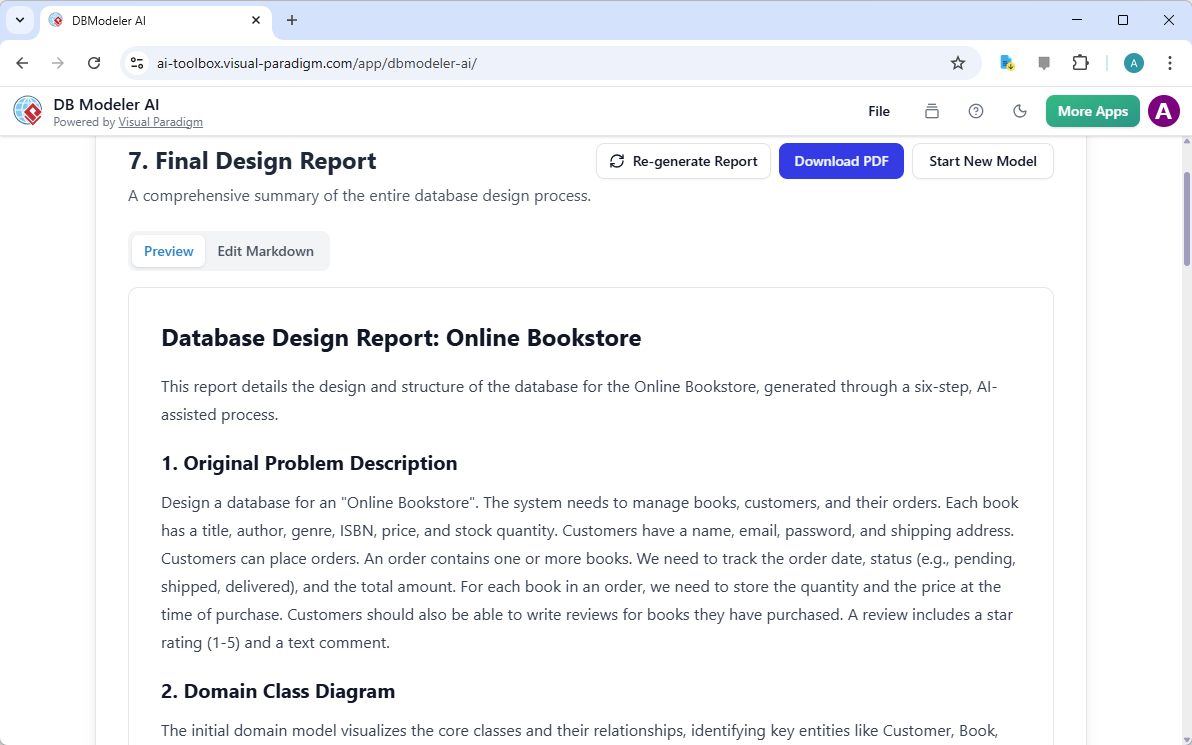
Finally, Step 7 consolidates your entire journey into a Final Design Report. This document is a goldmine for project managers and developers. It includes the original problem, every diagram, the normalized SQL, and the testing results. It’s not just a design; it’s a complete documentation package ready for your hand-off meeting!
Conclusion: The Future of Database Engineering
Visual Paradigm’s DB Modeler AI is more than just an easy-to-use database editor; it is a comprehensive engineering suite. By combining AI insight with a logical 7-step workflow, it eliminates the guesswork and manual labor that usually plagues the early stages of software development. Whether you are building a simple bookstore or a complex enterprise system, this AI-powered database design app ensures your data architecture is professional, normalized, and ready for the real world.
Stop wrestling with manual DDL and confusing diagrams! Experience the most efficient way to architect your data today. Try Visual Paradigm’s DB Modeler AI now by visiting the official application page or explore more features at the DB Modeler AI info site. Your future database—and your developers—will thank you!
Related Links
Database design involves utilizing Entity-Relationship Diagrams (ERD) and data modeling techniques to construct scalable, robust database architectures that align with business requirements. Modern platforms have significantly enhanced this process by integrating AI-driven tools such as DBModeler AI, which automates schema generation, database normalization, and SQL testing.
-
Database Design with ERD Tools – Visual Paradigm Guide: A comprehensive resource for building scalable databases using data modeling best practices and schema design.
-
What is an Entity-Relationship Diagram (ERD)?: An introductory guide explaining the core components and the essential role of ERDs in system development.
-
DBModeler AI: Intelligent Database Modeling Tool: An overview of an AI-driven tool used for rapid database design, generating ER diagrams, and creating testable environments.
-
How to Model a Relational Database with ERD: A practical tutorial that walks users through the process from conceptual design to full implementation.
-
Visual Paradigm ERD Tool – Complete Database Solution: A detailed look at a professional toolset used by architects to model, visualize, and generate databases efficiently.
-
Database Design Tutorial with Visual Paradigm: A comprehensive guide to leveraging visual modeling tools for robust database design and development.
-
Reverse Engineering Database to ERD: A step-by-step manual on transforming existing databases into visual models for documentation and analysis.
-
Streamlining ER Modeling from Concept to Implementation: An article focused on simplifying the transition from conceptual modeling to final database deployment.
-
How to Create Database Specifications: A guide for developing precise technical specifications to ensure consistency across the development lifecycle.
-
AI-Powered JSON-to-CRUD Table Generator: A specialized tool that uses AI to automatically generate dynamic CRUD tables and data structures from JSON inputs.